
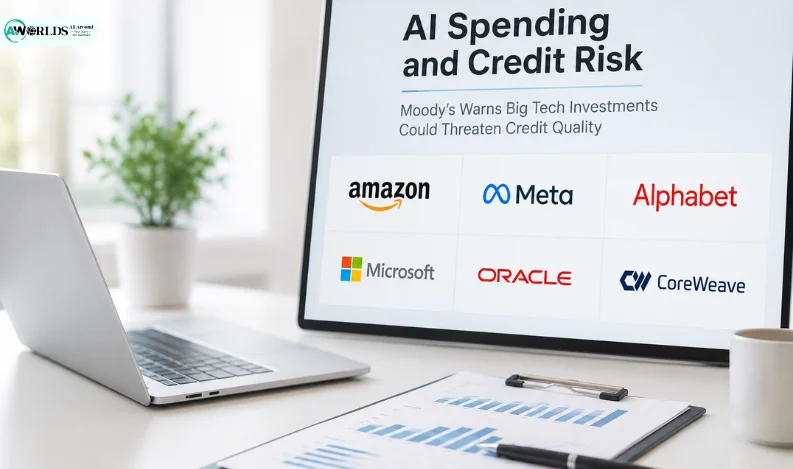
Moody's Warns AI Spending Could Weaken Big Tech Credit Quality
Massive investment in artificial intelligence infrastructure is beginning to reshape the financial profile of the world's largest technology companies, with Moody's Ratings warning that record spending could gradually weaken credit quality across the sector.
In a report released this week, Moody's said companies including Microsoft, Amazon, Alphabet, Meta, Oracle and CoreWeave are committing unprecedented levels of capital to build AI data centers, expand cloud infrastructure and acquire advanced computing hardware.
The ratings agency estimates AI-related capital expenditure will reach $785 billion in 2026 before climbing to around $1 trillion in 2027, marking one of the largest investment cycles the technology industry has experienced.
"The transition from asset-light to asset-heavy models requires unprecedented levels of investment and capital raising," Moody's said in the report.
According to the agency, companies that once relied primarily on software and cloud services are now investing heavily in physical infrastructure, placing increasing pressure on free cash flow while expanding borrowing requirements.
Moody's estimates that direct debt across the six companies has reached approximately $460 billion. At the same time, long-term data center lease commitments have grown to nearly $1.2 trillion, including more than $820 billion tied to facilities that are still under development.
Although these lease obligations are not recorded as conventional debt, Moody's said they represent significant long-term financial commitments that should be viewed as debt-equivalent liabilities.
To finance their expansion, several technology companies have also turned to capital markets. Alphabet recently announced an $85 billion equity offering, while others continue raising funds through debt issuance and structured financing arrangements.
Despite highlighting these risks, Moody's said the financial position of Microsoft, Alphabet, Amazon and Meta remains exceptionally strong, making any immediate threat to their investment-grade credit ratings unlikely.
The agency noted, however, that companies with lower credit ratings face greater challenges. Oracle currently carries a Baa2 rating with a negative outlook, while AI cloud provider CoreWeave remains in speculative-grade territory with a Ba3 rating.
Moody's also pointed to increasing interdependence within the AI industry. Several cloud providers have invested billions of dollars in artificial intelligence developers such as OpenAI and Anthropic, which in turn rely on those same companies for cloud computing services.
The agency described the arrangement as a "circular AI ecosystem," warning that growing dependence on a limited group of AI customers could increase financial concentration risks if demand slows.
Even so, Moody's said demand for AI computing remains robust, supported by expanding cloud businesses and hundreds of billions of dollars in long-term customer agreements.
The report concluded that while the industry's long-term outlook remains positive, investors are expected to pay closer attention to whether companies can generate sufficient returns on their enormous AI investments.
"Investors will increasingly focus on these companies' ability to realize an adequate return on investment," Moody's said.
More News:-






Recent Comments:
No comments yet.