
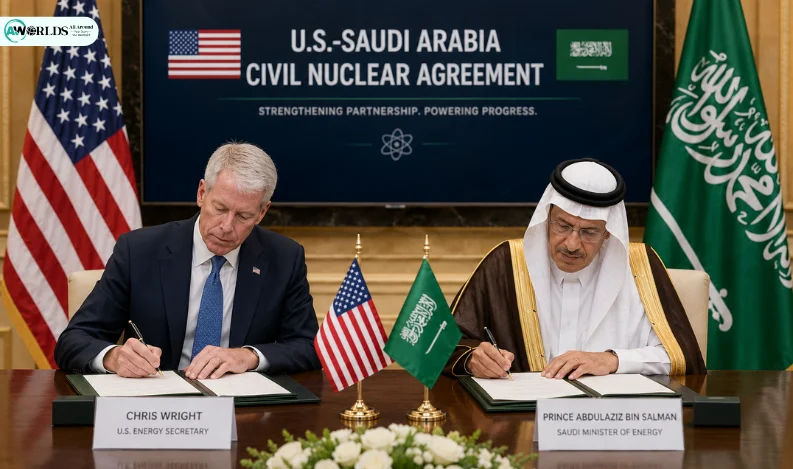
US, Saudi Arabia Sign Landmark Civil Nuclear Cooperation Agreement
The United States and Saudi Arabia have signed a landmark civil nuclear cooperation agreement that will allow the kingdom to develop a civilian nuclear energy programme, marking a significant step in bilateral energy and strategic relations.
The agreement was formally signed by US Energy Secretary Chris Wright and Saudi Energy Minister Prince Abdulaziz bin Salman. While the Trump administration did not disclose the full terms of the framework, officials said the pact includes bilateral non-proliferation safeguards and will support the development of Saudi Arabia's civilian nuclear sector using American technology.
According to US officials, the agreement is expected to remain in force for 30 years and is intended to strengthen long-term cooperation in the energy sector while maintaining nuclear safety standards.
In a statement following the signing, Wright said the agreement reflects both countries' commitment to expanding commercial ties and enhancing regional security.
He added that the framework upholds strict nuclear safety and non-proliferation standards while relying on US-developed nuclear technology and expertise.
The administration has not confirmed whether Saudi Arabia will be permitted to enrich uranium domestically. However, officials familiar with the framework said it could potentially provide the kingdom with enrichment capabilities, a provision that has drawn concern from some lawmakers.
Uranium enrichment is commonly used to produce fuel for civilian nuclear power plants, but the same technology can also be used to produce material suitable for nuclear weapons. The issue has prompted bipartisan scrutiny in Washington over the scope of Saudi Arabia's future nuclear programme.
US Secretary of State Marco Rubio sought to address those concerns, stating that the United States would not enter into any agreement that increases the risk of nuclear proliferation.
"The United States is not going to reach any agreement with any country that leads to the risk of proliferation," Rubio said while speaking to reporters during a visit to the Philippines.
The agreement reportedly does not include the International Atomic Energy Agency's (IAEA) Additional Protocol, which provides expanded inspection and verification measures for civilian nuclear facilities.
The framework will now be submitted to the US Congress for review. Although some lawmakers are expected to question aspects of the agreement, analysts believe its approval is likely given that Republicans currently hold majorities in both chambers.
The announcement comes amid heightened geopolitical tensions in the Middle East, where concerns over Iran's nuclear programme continue to shape US regional policy. Washington has repeatedly argued that preventing nuclear proliferation remains central to its security strategy, while Iran maintains that its nuclear activities are intended solely for peaceful purposes.
The agreement is expected to deepen energy cooperation between Washington and Riyadh while reinforcing the longstanding strategic partnership between the two countries.
More News:-






Recent Comments:
No comments yet.