
Japanese AI Winners Emerge Beyond Semiconductors as Traditional Firms Ride AI Boom
While global attention remains focused on semiconductor giants, several traditional Japanese manufacturers are quietly benefiting from the rapid expansion of artificial intelligence by supplying critical materials used in advanced chip production.
Companies better known for manufacturing toilets, glass fiber, and food seasoning have emerged among Japan's strongest-performing stocks this year as demand for AI infrastructure accelerates.
Toto, Nittobo, and Ajinomoto have each reported strong financial performances, driven by growing demand for products that play an important role in semiconductor manufacturing and advanced computing technologies.
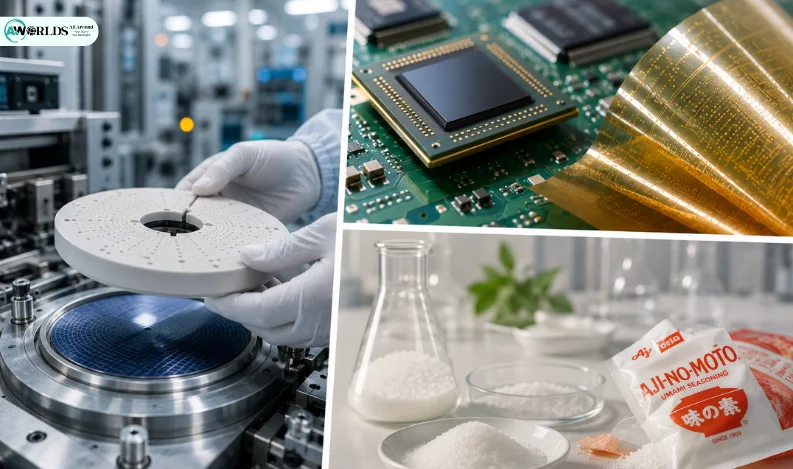
Toto, widely recognized for its bathroom products, has expanded its advanced ceramics business by producing ceramic electrostatic chucks used in semiconductor manufacturing equipment. These components help secure silicon wafers during chip production and are increasingly used in the manufacturing of advanced AI processors.
The company reported that revenue from its advanced ceramics division increased 34%, while operating profit rose 42% during the financial year ended March 31. The strong performance offset weaker results in its core housing equipment business.
Despite the growing profitability of its semiconductor-related operations, Toto said it has no plans to shift away from its traditional business and intends to maintain balanced growth across both divisions.
Glass fiber manufacturer Nittobo also benefited from rising demand linked to AI data centers and advanced semiconductor packaging.
Its specialized glass materials are used in printed circuit boards and semiconductor package substrates, which have become increasingly important as AI computing requirements continue to grow.
The company reported a 20.4% increase in sales and a 39.7% rise in operating profit for its electronic materials business, making it the primary contributor to overall company growth during the past financial year.
Nittobo said demand for special glass used in AI servers, networking equipment, and semiconductor packaging is expected to remain strong, prompting plans to further expand production capacity.
Food manufacturer Ajinomoto has also strengthened its position in the AI supply chain through its Ajinomoto Build-up Film (ABF), an insulating material widely used in high-performance semiconductor packaging.
Originally developed using technology derived from its amino acid research, ABF is now an essential component in advanced processors used for artificial intelligence, cloud computing, and next-generation data centers.
Ajinomoto reported that its Healthcare and Others business segment, which includes electronic materials such as ABF, recorded a 45.1% increase in business profit during the latest financial year, supported by growing semiconductor demand.
The company said advanced technologies including AI and 5G are expected to continue driving demand for semiconductor packaging materials in the years ahead.
The strong performances of these companies highlight how the AI boom is creating opportunities well beyond traditional chipmakers. As investment in artificial intelligence infrastructure continues to accelerate worldwide, manufacturers supplying specialized materials and components are becoming increasingly important players in the global semiconductor ecosystem.
Rather than producing chips themselves, Toto, Nittobo, and Ajinomoto are demonstrating that decades of expertise in ceramics, glass technology, and materials science can provide a competitive advantage in one of the world's fastest-growing industries.
More News:-





Recent Comments:
No comments yet.