
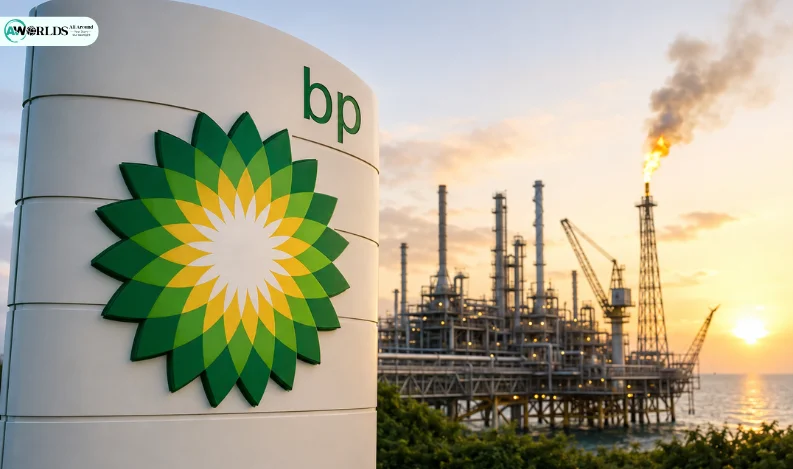
BP Quarterly Profit More Than Doubles as Middle East Conflict Lifts Oil Prices
British energy giant BP reported a sharp rise in second-quarter earnings on Tuesday, as higher oil and gas prices, stronger refining margins and volatile energy markets boosted its financial performance.
BP’s profit attributable to shareholders increased to $3.91 billion in the April-to-June quarter, compared with $1.63 billion during the same period last year. Its closely watched underlying replacement cost profit more than doubled to $5.73 billion from $2.35 billion a year earlier, exceeding analysts’ expectations.
The company said its results benefited from higher commodity prices, improved refining margins and strong energy-trading performance during a period of significant disruption in global oil and gas markets.
Middle East Tensions Support Energy Prices
Energy prices have risen amid the conflict involving the United States and Iran, which has disrupted supply routes and increased uncertainty surrounding global oil shipments.
The market volatility has benefited major energy companies, particularly their trading operations, as crude oil and natural gas prices moved sharply in response to geopolitical developments.
BP Chief Executive Meg O’Neill described the quarter as one of the most disrupted periods experienced by the global energy industry.
“This is my first full quarter at BP, and it has been marked by one of the most disrupted periods in the global energy market,” O’Neill said in the company’s results statement.
BP generated operating cash flow of $10.9 billion during the quarter, compared with $2.9 billion in the previous three-month period. The company also reduced its net debt to $22.25 billion from $25.31 billion at the end of the first quarter.
BP Raises Quarterly Dividend
Following the stronger earnings performance, BP increased its quarterly dividend by 4% to 8.66 cents per ordinary share.
The company said the increase reflected progress in strengthening its balance sheet and improving shareholder returns.
Despite the financial improvement, BP acknowledged that some areas of its operations performed below expectations.
Upstream production declined to 2.2 million barrels of oil equivalent per day, while plant reliability fell to 92.4% from 95.7% in the previous quarter. Refinery throughput and availability also decreased, partly because of planned maintenance and disruption linked to the Middle East conflict.
Company Accelerates Asset-Sale Programme
BP also announced plans to sell Archaea Energy, its US biogas business, as part of a broader effort to simplify its portfolio and concentrate investment on assets offering stronger financial returns.
The company acquired Archaea for approximately $4.1 billion in 2022 during an expansion into renewable energy but has since reduced investment in several low-carbon businesses.
BP recently completed the sale of its Gelsenkirchen refinery in Germany, agreed to sell its Austrian retail business and launched a process to sell its UK North Sea oil and gas operations.
The company is targeting approximately $20 billion in asset-sale proceeds by the end of 2027 and expects to have announced or completed between $15 billion and $16 billion of disposals by the end of 2026.
O’Neill Promises Operational Overhaul
O’Neill, who became BP’s chief executive in April, said the company had not consistently delivered the level of performance expected by management or shareholders.
She outlined priorities including strengthening BP’s balance sheet, simplifying its asset portfolio, improving operational reliability and applying stricter discipline to future investments.
“We are not making the most of our potential,” O’Neill said, adding that BP needed to become more financially resilient and focus on businesses capable of delivering competitive long-term returns.
BP now expects its 2026 capital expenditure to range between $13.5 billion and $14 billion.
The company’s improved earnings demonstrate how higher energy prices and geopolitical uncertainty have strengthened profits across the oil industry. However, BP’s future performance will also depend on its ability to improve operations, reduce debt and complete its planned asset disposals.
More News:-







Recent Comments:
No comments yet.