
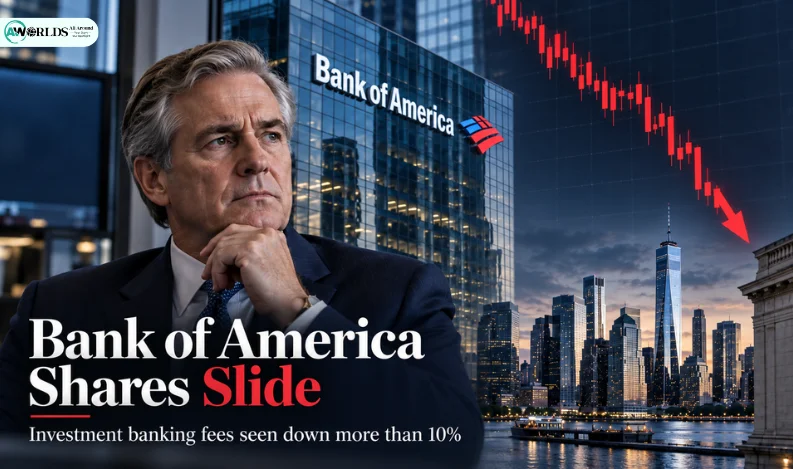
Bank of America Expects Third-Quarter Investment Banking Fees to Fall More Than 10%; Shares Slide
Bank of America shares fell sharply on Monday after CEO Brian Moynihan warned that the bank's third-quarter investment banking fees are expected to decline by more than 10% from a year earlier.
The warning sent the bank's shares down more than 5%, while the broader S&P 500 banking index also declined. Investors reacted to signs that the strong rebound in Wall Street dealmaking may be losing some momentum.
Investment Banking Revenue Expected to Drop
Moynihan said Bank of America's investment banking revenue is likely to come in between $1.6 billion and $1.8 billion for the third quarter, compared with approximately $2 billion during the same period in 2025.
He said the broader investment banking market is down around 10%, while Bank of America expects to perform somewhat worse because it has less exposure to some of the areas that have remained relatively active.
The forecast marks a notable change after a strong first half of the year, when Wall Street benefited from increased mergers and acquisitions, initial public offerings and equity-market activity.
Strong Second Quarter Made the Outlook More Difficult
Bank of America's investment banking fees surged 50% in the second quarter, helping the bank deliver stronger-than-expected results in July.
That creates a difficult comparison for the current quarter. Even if deal activity remains historically healthy, the unusually strong results from a year earlier mean Wall Street banks now face tougher comparisons and potentially slower growth.
Industrywide, deal activity has remained substantial, but the pace of investment banking revenues has weakened in areas including advisory services and debt capital markets.
Trading Revenue Expected to Stay Flat
Moynihan also said Bank of America's sales and trading revenue is expected to remain roughly flat year over year at around $5.4 billion.
While that may sound disappointing after a long period of strong trading growth, the CEO described the expected performance as relatively solid for the third quarter.
Trading businesses have benefited from elevated market volatility, which has encouraged institutional investors and hedge funds to increase activity across stocks, bonds and other financial markets.
Deal Pipeline Remains Strong
Despite the weaker fee outlook, Moynihan said the bank's underlying deal pipeline remains healthy.
He expressed confidence in the U.S. economy and said corporate activity has not dried up. However, he warned that a potential increase in interest rates could slow financing demand, particularly for companies considering new debt or other capital-market transactions.
That creates an important risk for the rest of the year, especially as investors anticipate further changes in U.S. monetary policy.
Higher Rates Could Put More Pressure on Dealmaking
The investment banking slowdown comes as financial markets prepare for another potential Federal Reserve rate increase.
Higher borrowing costs can make acquisitions more expensive and reduce companies' willingness to issue debt or pursue large transactions. A prolonged period of elevated rates could therefore place additional pressure on investment banking revenues.
At the same time, stronger-than-expected economic activity can continue supporting corporate confidence and dealmaking, creating a complicated outlook for banks.
Bank Stocks Feel the Impact
Bank of America was the biggest decliner among several major U.S. financial companies following Moynihan's comments.
Citigroup, JPMorgan Chase and Goldman Sachs also moved lower as investors reassessed expectations for Wall Street's revenue growth. The reaction suggests that investors may have been pricing in a longer period of exceptional performance from the industry's trading and dealmaking businesses.
The selloff was therefore broader than one bank, reflecting concerns that the easy gains from the post-market-recovery deal boom may be becoming harder to repeat.
Wall Street Faces a More Mixed Second Half
Bank of America's outlook does not point to a collapse in corporate dealmaking. Instead, it suggests that the sector is moving into a more normal environment after a particularly strong period.
Mergers, acquisitions and capital-market transactions remain active, but tougher comparisons and interest-rate uncertainty are making it more difficult for banks to maintain the rapid revenue growth seen earlier in the year.
For Bank of America, the immediate focus will be on whether its strong deal pipeline can compensate for weaker investment banking fees and flat trading revenue.
The latest warning offers a reminder that even as Wall Street remains busy, the exceptional growth that powered investment banking earlier in 2026 may be starting to cool.
More News:-





Recent Comments:
No comments yet.