
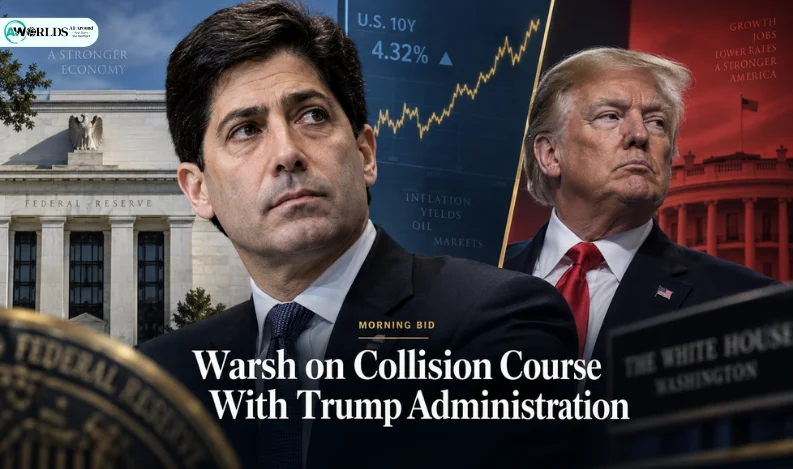
Morning Bid: Warsh on Collision Course With Trump Administration
Federal Reserve Chair Kevin Warsh is facing a difficult policy decision that could deepen tensions with the Trump administration, as the central bank prepares to announce its latest interest-rate decision.
Markets are widely expecting the Fed to raise its benchmark rate by 25 basis points on Wednesday, even as President Donald Trump continues to push publicly for lower borrowing costs. The disagreement puts Warsh in a particularly sensitive position only months into his tenure as Fed chair.
Inflation Creates a Difficult Choice
The central issue facing Warsh and other Fed policymakers is persistent inflation.
U.S. consumer prices rose 3.4% year over year in August, while core inflation accelerated more than economists had expected. At the same time, oil prices have surged above $100 a barrel amid disruption and geopolitical tensions in the Middle East, creating another potential source of inflation.
Those pressures make a rate increase easier to justify from an inflation-control perspective, but higher borrowing costs could also weigh on economic activity and financial markets.
Trump Continues to Push for Lower Rates
Trump has repeatedly argued that U.S. interest rates should be much lower.
Just days before the Fed meeting, he said the United States should have the world’s lowest interest rate, adding to pressure on the central bank as policymakers consider how aggressively to respond to inflation.
The administration has previously criticized the Fed for keeping rates too high, while Warsh has emphasized that monetary-policy decisions should be based on economic conditions rather than political demands.
That difference could become more visible after Wednesday’s announcement, particularly if the Fed signals that rates may need to remain restrictive.
Warsh’s Independence Is Under Scrutiny
Warsh took over as Fed chair in May 2026, after being confirmed by the Senate. During his confirmation process, he said he had made no promises to Trump regarding interest-rate cuts and intended to preserve the central bank’s independence.
He has also described his approach as a broader reform of the Federal Reserve, including changes to the central bank’s balance sheet and its coordination with the Treasury on non-monetary matters.
That background has made Wednesday’s decision more significant. Investors will be watching not only the rate itself but also how Warsh explains the Fed’s outlook.
Bond Yields Raise the Stakes
The debate is unfolding against a backdrop of sharply higher government bond yields.
The 10-year U.S. Treasury yield briefly moved above 5% on Wednesday, its highest level in about three years, before easing back below that mark. Investors are increasingly focused on whether inflation, energy prices and expectations for future Fed policy will keep yields elevated.
Higher Treasury yields can increase borrowing costs throughout the economy, from mortgages and corporate loans to government financing.
That means the Fed’s message could have an immediate impact well beyond currency markets.
Markets Focus on the Fed’s Guidance
The expected 25-basis-point increase is already largely reflected in financial markets, with futures indicating a probability above 90% before the decision.
As a result, investors are likely to pay particular attention to Warsh’s economic projections and comments about the path of interest rates.
A clearer signal that additional increases may be necessary could push bond yields and the dollar higher. A more cautious message could have the opposite effect and revive expectations for eventual rate cuts.
Oil Adds Another Layer of Uncertainty
Energy markets are complicating the Fed’s calculations.
Brent crude has remained above $100 a barrel, driven by severe disruptions to Middle Eastern energy supplies. The higher cost of oil threatens to feed into transportation, manufacturing and household expenses, potentially making inflation harder to bring back toward the Fed’s target.
At the same time, sustained high oil prices can weaken consumer spending and economic growth, creating a difficult balance for monetary policymakers.
A Defining Moment for Warsh
For Warsh, Wednesday’s meeting could become an important test of how he intends to lead the Federal Reserve.
The challenge is not simply whether to raise or hold interest rates. It is how the central bank communicates its response to inflation while maintaining credibility and managing the economic effects of higher borrowing costs.
The decision could also shape perceptions of the relationship between the White House and the Fed. Trump is seeking cheaper money, while current economic conditions are pushing policymakers to consider whether tighter policy is still necessary.
With markets already pricing in a rate increase, Warsh’s words may prove just as important as the decision itself. The Fed’s guidance will offer investors a clearer indication of how the new chair intends to navigate inflation, growth and the increasingly visible tension between monetary policy and the administration’s economic priorities.
More News:-




Recent Comments:
No comments yet.