
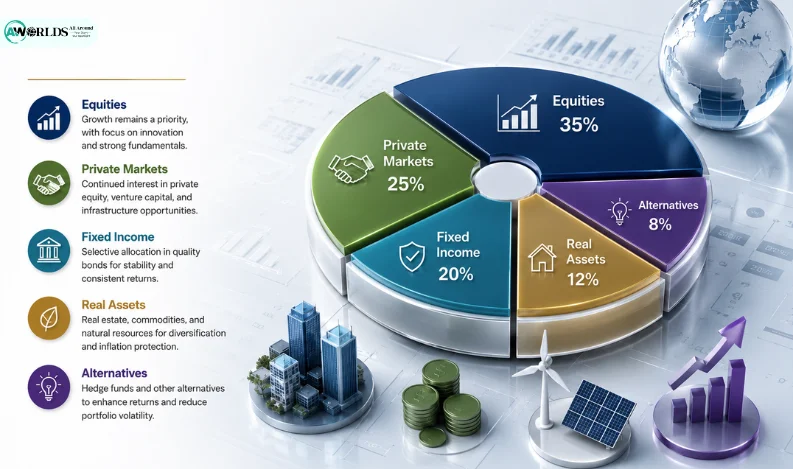
Where Investors Are Actually Allocating Capital in 2026
Investment patterns in 2026 reflect a more disciplined and calculated approach than in previous years. After cycles of aggressive growth investing and market volatility, capital allocation has shifted toward sectors that demonstrate stability, resilience, and measurable returns.
This is not a slowdown in investment activity. Instead, it marks a transition toward more structured decision-making, where investors are prioritizing long-term value over short-term momentum.
Understanding where capital is flowing today requires looking beyond headlines and examining the underlying logic driving these decisions.
A Changing Investment Environment
Several structural changes are influencing how investors operate in 2026.
Higher interest rates have increased the cost of capital, making speculative investments less attractive. At the same time, global uncertainty—ranging from geopolitical tensions to supply chain disruptions—has reinforced the need for risk-aware strategies.
As a result, investors are focusing on:
- Strong balance sheets
- Predictable cash flows
- Scalable yet sustainable business models
This shift is shaping capital flows across multiple sectors.
Infrastructure and Energy: Long-Term Stability Returns to Focus
Infrastructure and energy have emerged as key areas of investment, driven by both economic necessity and policy support.
Governments worldwide are allocating significant resources toward infrastructure development, while energy security remains a central concern in global markets.
Investment is being directed toward:
- Renewable energy projects such as solar and wind
- Traditional energy systems including oil and gas infrastructure
- Grid modernization and energy storage solutions
These sectors offer long-term visibility, supported by regulatory frameworks and consistent demand. For investors, this translates into predictable returns with lower volatility compared to high-growth sectors.
Artificial Intelligence: From Broad Interest to Targeted Investment
Artificial intelligence continues to attract capital, but the investment approach has matured.
Earlier enthusiasm for AI was driven largely by potential. In 2026, the focus has shifted toward practical application and monetization.
Investors are prioritizing companies that:
- Integrate AI into enterprise workflows
- Deliver measurable efficiency improvements
- Demonstrate clear revenue generation
Rather than funding experimental solutions, capital is flowing into businesses that can prove real-world impact. This marks a transition from speculative investment to performance-based evaluation.
Healthcare and Life Sciences: Consistent and Defensive Growth
Healthcare remains one of the most reliable sectors for long-term investment.
Its resilience is supported by structural factors such as aging populations, increased healthcare demand, and continuous innovation in medical technology.
Key areas attracting capital include:
- Diagnostics and preventive healthcare
- Digital health platforms and remote care solutions
- Biotechnology and pharmaceutical research
Unlike many industries, healthcare demand is not closely tied to economic cycles, making it a defensive yet growth-oriented sector.
Emerging Markets: Selectivity Over Broad Exposure
Emerging markets continue to present growth opportunities, but investor strategies have become more selective.
Instead of broad regional investments, capital is being allocated to markets with:
- Stable regulatory environments
- Infrastructure development
- Strong domestic consumption trends
Regions in Southeast Asia, parts of the Middle East, and select African economies are attracting attention, particularly where governments are actively supporting economic diversification.
This approach reflects a shift toward precision investing, where decisions are based on specific market conditions rather than general growth narratives.
Real Assets: A Strategic Hedge Against Volatility
In an environment characterized by uncertainty, real assets have regained importance.
These include:
- Real estate, particularly logistics and industrial spaces
- Commodities such as energy and metals
- Agricultural investments
Real assets provide a hedge against inflation and offer tangible value, making them a key component of diversified investment portfolios.
Their growing relevance highlights a broader investor preference for capital preservation alongside growth.
Private Markets: Long-Term Value Creation
Private markets are playing an increasingly significant role in investment strategies.
With public markets experiencing volatility, investors are allocating capital toward:
- Private equity
- Private credit
- Select venture capital opportunities
These investments offer the advantage of reduced exposure to short-term market fluctuations and a stronger focus on long-term value creation.
However, the approach is more disciplined than in previous years, with greater emphasis on due diligence and sustainable growth.
Profitability and Cash Flow: The Core Focus
One of the most defining characteristics of investment trends in 2026 is the renewed focus on financial fundamentals.
Investors are prioritizing businesses that demonstrate:
- Consistent revenue streams
- Strong cash flow generation
- Clear paths to profitability
The earlier emphasis on rapid growth without financial discipline has diminished significantly.
Today, capital is flowing toward companies that can combine growth with operational efficiency and financial stability.
Conclusion
The investment landscape in 2026 is defined by clarity, discipline, and a focus on long-term value.
Rather than chasing emerging trends, investors are making decisions based on:
- Measurable performance
- Sustainable business models
- Strategic positioning within evolving markets
This shift represents a more mature phase in global investing, where capital is deployed with greater intention and precision.
For businesses, the implication is clear: attracting investment today requires not just vision, but execution, consistency, and financial strength.







Recent Comments:
No comments yet.