
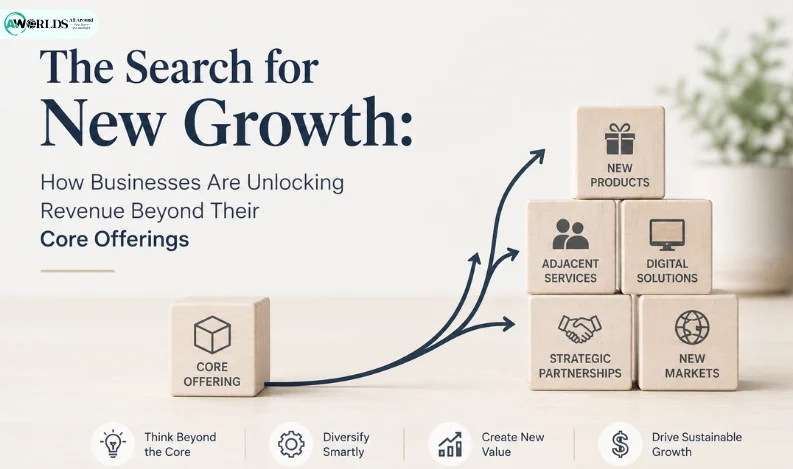
The Search for New Growth: How Businesses Are Unlocking Revenue Beyond Their Core Offerings
For many businesses, growth was once relatively predictable. Companies expanded by increasing sales, entering new markets, launching additional products, or investing in larger operations. While those strategies remain relevant, the business environment has become significantly more complex. Economic uncertainty, changing consumer behavior, rising operational costs, technological disruption, and increasing competition have forced organizations to rethink how sustainable growth is achieved.
Across industries, executives are recognizing that relying too heavily on a single product, service, customer segment, or revenue source can create vulnerability. Markets change, customer preferences evolve, and competitive advantages rarely remain permanent. As a result, many organizations are shifting their focus from simply growing existing revenue streams to actively creating new ones.
This shift is not limited to large multinational corporations. Businesses of all sizes, from startups and family-owned enterprises to global organizations, are exploring new ways to generate value, diversify income, and strengthen long-term resilience. In many cases, these new revenue streams are becoming critical drivers of profitability and future growth.
The companies succeeding in today's marketplace are not necessarily those with the biggest budgets or the largest customer bases. More often, they are the organizations willing to challenge traditional assumptions about how revenue is generated and where future opportunities may exist.
Why Revenue Diversification Has Become a Strategic Priority
Business leaders have become increasingly aware of the risks associated with overdependence on a single source of income. Recent years have demonstrated how quickly external conditions can change. Economic slowdowns, inflationary pressures, supply chain disruptions, regulatory changes, and shifts in consumer spending patterns have all highlighted the importance of financial flexibility.
Organizations that generate revenue from multiple sources are often better positioned to withstand periods of uncertainty. When one segment experiences slower growth, other revenue channels can help maintain stability and support continued investment.
This is one of the reasons revenue diversification has become a recurring topic in executive meetings and strategic planning sessions. Companies are not abandoning their core business models. Instead, they are looking for ways to build additional layers of growth around existing strengths.
In many cases, the most promising opportunities are not entirely new. They emerge from capabilities, expertise, customer relationships, or assets that businesses already possess but have not fully monetized.
Looking Beyond the Core Business
One of the most significant changes taking place across industries is a shift in how organizations view their own value.
Historically, many businesses defined themselves by the products they sold. Today, successful organizations increasingly define themselves by the problems they solve.
This distinction is important because it opens the door to entirely new opportunities.
A company that once viewed itself solely as a software provider may discover opportunities in consulting, training, implementation support, or data services. A manufacturer may expand into predictive maintenance, monitoring solutions, or subscription-based support programs. A retailer may develop membership programs, exclusive customer experiences, or digital services that extend beyond traditional transactions.
By focusing on customer needs rather than existing offerings, businesses often uncover additional ways to create value, and generate revenue.
The most innovative organizations understand that customers rarely purchase products for their own sake. They purchase outcomes, solutions, convenience, expertise, and experiences. Businesses capable of delivering those elements through multiple channels often create stronger and more sustainable revenue models.
The Rise of Recurring Revenue
Perhaps one of the most significant developments in modern business is the growing appeal of recurring revenue.
Predictable income streams have become increasingly attractive in a world where market conditions can change quickly. Businesses are recognizing that long-term customer relationships often create greater value than one-time transactions.
This realization has led organizations across multiple industries to explore recurring revenue models.
What began primarily in the software industry has expanded into sectors ranging from education and healthcare to manufacturing, professional services, retail, and media.
Businesses are creating recurring revenue through:
-
Subscription-based services
-
Membership programs
-
Maintenance and support agreements
-
Managed service offerings
-
Premium content platforms
-
Ongoing consulting relationships
The appeal of these models extends beyond financial predictability. They also encourage stronger customer engagement, improve retention rates, and increase lifetime customer value.
For many organizations, recurring revenue is becoming a cornerstone of long-term growth strategies.
Turning Expertise Into a Revenue Opportunity
One of the most overlooked assets within many organizations is knowledge.
Every successful business develops expertise through years of experience, problem-solving, customer interactions, and industry involvement. Increasingly, companies are recognizing that this expertise can become a valuable commercial offering in its own right.
Across industries, businesses are monetizing knowledge through advisory services, workshops, training programs, certification courses, industry research, and educational content.
This trend reflects a broader shift in the economy. Customers are not simply purchasing products; they are seeking guidance, insights, and expertise that help them achieve better outcomes.
Organizations that position themselves as trusted advisors often strengthen customer relationships while creating entirely new revenue streams.
In many cases, knowledge-based services also require lower operational investment than physical products, making them particularly attractive from a profitability perspective.
Digital Channels Are Expanding Growth Opportunities
Digital transformation has fundamentally changed how businesses reach customers and deliver value.
Geographical limitations that once constrained growth have become far less significant. Companies can now deliver services, expertise, education, and experiences to customers around the world through digital platforms.
This shift has created opportunities that would have been difficult to imagine just a decade ago.
Businesses are increasingly generating revenue through online learning platforms, digital consulting services, virtual events, premium communities, downloadable resources, and subscription-based digital products.
These models often offer greater scalability than traditional business approaches because they allow organizations to serve larger audiences without proportional increases in operational costs.
As customer behavior continues to evolve, digital channels are likely to play an even greater role in future revenue strategies.
How Leading Businesses Are Creating New Revenue Streams
While approaches vary across industries, several strategies are consistently emerging among successful organizations:
Revenue Strategies Gaining Momentum
-
Subscription and membership models
-
Premium customer experiences
-
Digital education and training services
-
Consulting and advisory offerings
-
Strategic partnerships and collaborations
-
Licensing intellectual property
-
Data-driven services and analytics
-
Managed service solutions
-
Industry-specific marketplaces
-
Community-based business models
What makes these strategies effective is not simply their novelty but their ability to build upon existing business strengths.
Innovation Is Becoming a Revenue Discipline
For many years, innovation was often associated with product development. Today, innovation is increasingly focused on business models, customer experiences, and revenue generation itself.
Leading organizations are continuously asking new questions:
- Where else can we create value?
- What additional problems can we solve for customers?
- How can existing capabilities be used more effectively?
- What unmet needs exist within our market?
These questions often lead to opportunities that traditional growth strategies overlook.
The businesses creating the most successful new revenue streams are rarely chasing trends. Instead, they are carefully observing customer behavior, market developments, and operational capabilities to identify practical opportunities for expansion.
Looking Ahead
The search for new revenue streams is ultimately about more than financial growth. It is about building organizations capable of adapting to change, reducing risk, and creating lasting value in increasingly competitive markets.
The most successful businesses are moving beyond the idea that growth must come exclusively from selling more of the same products to the same customers. They are exploring new models, leveraging existing strengths, and identifying opportunities hidden within their own operations.
As competition continues to intensify across industries, organizations that diversify revenue sources will be better positioned to navigate uncertainty and capitalize on future opportunities.
The businesses that thrive in the years ahead are unlikely to be those that simply protect existing revenue streams. They will be the ones who continuously discover new ways to create value and transform that value into sustainable growth.
For more Information:-






Recent Comments:
No comments yet.