
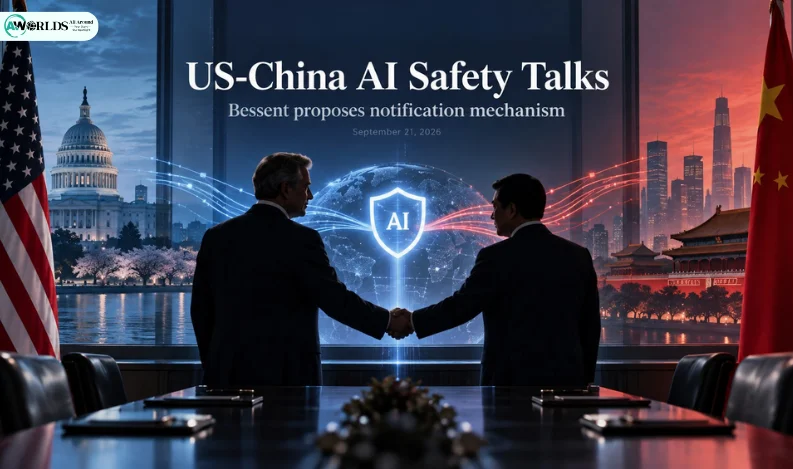
Bessent Proposes US-China AI Safety Notifications in Talks With Chinese Vice Premier
U.S. Treasury Secretary Scott Bessent has proposed creating a new U.S.-China artificial intelligence safety notification mechanism, in an effort to improve communication between the world's two leading AI powers over incidents that could pose national security risks.
The proposal was discussed during talks between Bessent and Chinese Vice Premier He Lifeng in New York on Sunday, just days before U.S. President Donald Trump and Chinese President Xi Jinping are scheduled to meet in Washington. Bessent said greater transparency would be important when dealing with potentially serious AI-related threats.
New AI Dialogue Would Focus on Security
According to Bessent, Washington wants to establish a formal AI dialogue between the United States and China.
A proposed notification system would cover AI incidents serious enough to raise national security concerns. The goal would be to give both governments a way to communicate about emerging threats rather than discovering potentially dangerous developments after they occur.
Bessent said the system could focus on shared risks and common objectives, particularly as AI becomes increasingly capable and is used across civilian, commercial and potentially military applications.
Proposal Comes Ahead of Trump-Xi Summit
The discussions in New York were part of preparations for the upcoming Trump-Xi summit on September 24.
The two countries are expected to discuss a broad range of issues, including trade, technology, critical minerals and AI. The proposed AI mechanism could give the leaders another area for cooperation even as disagreements over advanced semiconductor technology remain unresolved.
Bessent described the talks with He as “very successful,” although the two sides did not announce a major breakthrough on the most sensitive technology disputes.
China’s Response Remains Unclear
Beijing's response to the proposed notification mechanism has not been clearly stated.
He and China's chief trade negotiator Li Chenggang left the meeting without speaking to reporters. Chinese officials have not publicly committed to the proposed framework, leaving uncertainty over whether the mechanism will become a formal bilateral arrangement.
That uncertainty reflects the broader complexity of U.S.-China technology relations, where both countries are simultaneously competing for AI leadership and discussing ways to manage the risks associated with the technology.
Advanced AI Chips Are a Separate Issue
Bessent's proposal does not appear to cover the most contentious U.S. restrictions on advanced AI technology exports.
U.S. Trade Representative Jamieson Greer said that export controls covering sophisticated AI chips and semiconductor manufacturing equipment were not part of the AI mechanism discussions. Those restrictions remain a separate issue in the broader bilateral relationship.
The distinction is important because Washington and Beijing continue to disagree over access to advanced computing technology, even as they look for limited areas of cooperation.
Growing Concerns Over AI Risks
The proposal comes amid increasing concern about what increasingly powerful AI systems could mean for national security.
U.S. and Chinese security experts have recently discussed safeguards similar to those used in arms-control arrangements, including human oversight of critical military systems and direct communication channels for AI-related incidents. Neither government has formally adopted those recommendations.
AI companies have also been debating how quickly frontier systems should be developed. Anthropic CEO Dario Amodei, for example, has called for “pacing the frontier” to give safety measures more time to keep up with increasingly capable models.
AI Becomes Part of Wider US-China Competition
Artificial intelligence has become increasingly important to the strategic relationship between Washington and Beijing.
Both countries view advanced AI as critical to economic competitiveness, technological leadership and national security. At the same time, officials are concerned about cyberattacks, autonomous systems, AI-enabled weapons and other potential risks.
That creates a difficult balancing act: Washington and Beijing want to maintain their technological advantages while avoiding incidents that could escalate into wider security confrontations.
Trade Discussions Continue Alongside AI Talks
The AI proposal was only one part of the New York discussions.
U.S. and Chinese officials also discussed trade issues, including possible tariff reductions on some non-sensitive goods and the creation of a bilateral Board of Trade to continue economic consultations. However, major disagreements over critical minerals and technology controls remain.
The talks are intended to lay groundwork for the Trump-Xi meeting later this week rather than resolve every outstanding dispute.
A Potential New Communication Channel
If adopted, the AI notification mechanism would create a new channel for Washington and Beijing to communicate about serious AI-related incidents.
For now, it remains a U.S. proposal rather than a finalized agreement. Its eventual scope, reporting requirements and level of government involvement would need to be negotiated by both countries.
The idea nevertheless marks a notable development in the growing AI relationship between the United States and China. As competition over advanced AI intensifies, the two governments are increasingly being pushed to address not only who leads the technology race, but also how they will communicate when AI creates risks that cross national borders.
More News:-




Recent Comments:
No comments yet.