
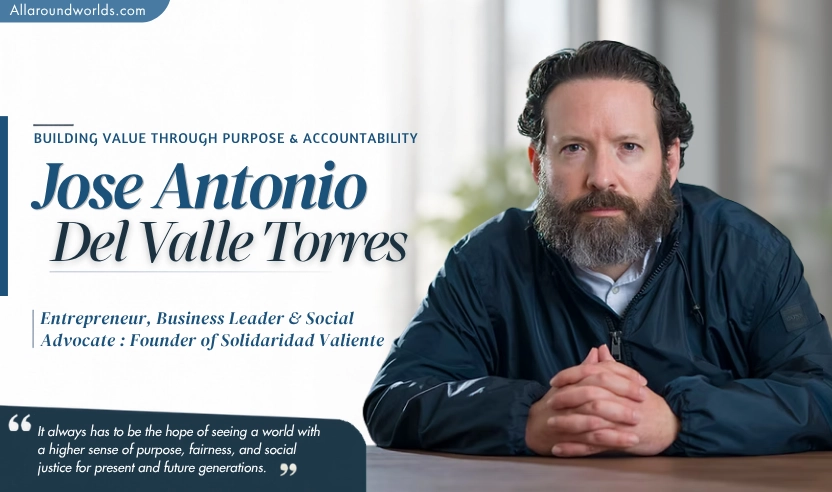
The Courage to Stand: José Antonio del Valle Torres’ Journey of Innovation and Purpos
Some journeys change direction because of opportunity; others are transformed by the moments that challenge everything a person has built and believed in. For Jose Antonio Del Valle Torres, more than 25 years across corporate leadership, entrepreneurship, innovation, and social advocacy have shaped a journey defined not only by creating value, but also by learning what it takes to defend it.
From developing the innovative functional beverage GO GABA and building his entrepreneurial career to becoming involved in a high-profile dispute with one of the world’s largest multinational corporations, Jose Antonio has encountered experiences that profoundly reshaped his understanding of business, institutional accountability, and the balance of power between individuals and global organizations. What began as an entrepreneurial journey eventually expanded into deeper questions about justice, democratic institutions, and the responsibility societies have to protect innovation and individual rights.
Those experiences also contributed to the creation of Solidaridad Valiente, through which Jose Antonio seeks to promote social justice, national unity, civic responsibility, and a positive vision of Mexico and its people. In this conversation with AllAroundWorlds, he reflects on the defining moments of his career, the personal and professional consequences of adversity, the realities entrepreneurs can face when challenging powerful systems, and the sense of purpose that continues to guide him. Read on to discover a journey where entrepreneurship evolved into advocacy, and where even profound challenges strengthened a determination to pursue fairness, accountability, and meaningful change.
A Journey Shaped by Innovation
Across more than 25 years in business, Jose Antonio Del Valle Torres has experienced several defining moments that fundamentally changed his understanding of entrepreneurship and his role within it.
The first came during the early years of his career while working for one of the biggest business conglomerates in his native country. It was there that he began to understand the importance of constant innovation in delivering better outcomes to the market while simultaneously pursuing internal excellence.
Another defining period arrived when he established his first company. Moving from the corporate environment into entrepreneurship required Jose Antonio to develop an entirely new set of capabilities, from understanding how to incorporate an enterprise to ensuring its optimal functionality and day-to-day operation.
His perspective would change even more profoundly after entering into an agreement with one of the world’s largest multinational corporations, a business relationship that subsequently developed into a prolonged and ongoing dispute. According to Jose Antonio, the experience forced him to understand business from another dimension: not simply how value is created, but how the value of one’s work and fundamental rights may need to be defended.
“I’ve had to understand how to defend the value of work and fundamental human rights.”
The GO GABA Turning Point
One of the most consequential chapters of Jose Antonio’s entrepreneurial journey centers on GO GABA, the functional beverage he created. The product, a ‘Brain Booster’ was developed around a unique recipe of natural ingredients and received recognition including High Potential from Google, High Impact Scale Up from Mexico’s Ministry of Economy, and an innovation recognition from the French Chamber of Commerce.
Jose Antonio entered into an agreement with the Mexican subsidiary of The Coca-Cola Company in December 2017 concerning the development of GO GABA. He later filed two criminal complaints against The Coca-Cola Company / subsidiaries / executives for fraud and theft of industrial property. According to the official opinion of Mexico City’s General Attorney’s Office the losses ascended to more than USD $300 million.
For Jose Antonio, however, the dispute became far more than a commercial disagreement.
He says the chapter affected virtually every dimension of his life. He lost his business and became separated from his country, and his family, having to live in self-imposed exile because of well-founded concerns for his safety, according to security experts.
Based on his experience with the dispute, Jose Antonio believes the situation also exposed serious weaknesses within Mexican institutions. He argues that obtaining timely justice becomes extraordinarily difficult when significant economic and state interests intersect. In his view, this problem extends beyond Mexico, reflecting a broader international challenge in which individuals can struggle to obtain accountability when confronting exceptionally powerful organizations.
Confronting an Imbalance of Power
The experience fundamentally altered Jose Antonio’s understanding of the relationship between individuals and multinational corporations.
He sees an inherent imbalance in how the two can be held accountable. Individuals generally operate within clearly defined legal jurisdictions, while multinational businesses function through complex corporate structures spanning numerous countries and legal systems.
Jose Antonio argues that corporations can present themselves as a unified global brand when commercially advantageous while simultaneously operating through multiple separate legal entities across jurisdictions to avoid accountability. In disputes, he believes this structure can make responsibility considerably more difficult to establish and more challenging to pursue.
His experience has therefore led him to examine a much broader question: how can legal and democratic institutions remain effective when confronted by organizations possessing enormous financial resources and international influence?
For Jose Antonio, the answer goes beyond one corporation or one dispute. It concerns whether institutions can consistently protect individuals and uphold the public interest regardless of the economic power involved.
Confronting an Imbalance of Power
A few years into his dispute, Jose Antonio began thinking more deeply about what he describes as the tension between global capitalism and local democracies.
He believes local institutions can sometimes find themselves under considerable pressure when the public interest conflicts with powerful economic interests. Public officials and institutions responsible for protecting democratic principles may become compromised, in his view, when global economic pressure impacts political agendas.
This realization changed how he viewed political promises, institutional responsibility, and social justice. What can appear straightforward in political discourse, he observes, becomes considerably more complicated when those principles must be applied within real economic and institutional systems.
For Jose Antonio, the experience demonstrated that sustainable economic development should not require societies to choose between attracting global capital and protecting their citizens.
Global Capital and Local Democracy
His experiences have similarly reshaped his perspective on entrepreneurship.
Governments around the world frequently promote entrepreneurship and innovation as engines of economic development. Yet Jose Antonio believes there remains a substantial gap between encouraging people to create businesses and providing the institutional environment required for those businesses to survive and grow.
Cash-flow difficulties and poor management can undermine young companies, but he also sees inadequate institutional support as an important part of the problem. Entrepreneurs need more than encouragement; they require well-supported ecosystems capable of helping viable businesses navigate their formative years.
Jose Antonio is particularly concerned about what happens when promising ideas and innovations fail to reach their potential, are acquired for comparatively insignificant value, or are developed by larger industry players without what he considers appropriate compensation for their original innovators.
The consequence, he believes, extends beyond individual entrepreneurs. When creative people conclude that innovation cannot be adequately protected or rewarded, society risks discouraging precisely the talent responsible for creating future global progress.
Rethinking Entrepreneurial Support
Jose Antonio says his own experience demonstrates that the legal system has failed to provide the protection to which he is entitled as a Mexican citizen provided his constitutional guarantees. He says those failures subsequently extended to his experiences with international authorities and institutions provided the toxic political ‘behind closed doors’ influence of The Coca-Cola Company across the planet.
Navigating this reality has required persistence.
For Jose Antonio, continuing means presenting over and over again documentation and evidence before the authorities responsible both for securing justice and protecting his life. Unfortunately, an International Human Rights Organization affiliated to United Nations (UN) told us, if an honest assessment was made both have failed provided that justice has been perverted, and his life remains at risk. The process has strengthened his conviction that institutional accountability cannot simply be assumed; individuals must continue demanding it even when doing so requires extraordinary personal effort.
The Pursuit of Accountability
The experience eventually contributed to a broader mission.
In 2021, Jose Antonio founded Solidaridad Valiente (Brave Solidarity), a Mexican civic and social movement focused on national unity, social justice, institutional accountability, and highlighting the country’s strengths.
The initiative emerged after Jose Antonio wrote an open letter to then-President Andrés Manuel López Obrador raising allegations of institutional government corruption in favor of The Coca-Cola Company in his legal case. Although the Presidential Office initially made immediate efforts to address the situation, the corruption and the irregularities he had identified persisted and magnified even into the current administration of Mexican President Claudia Sheinbaum Pardo.
Rather than allowing the experience to remain exclusively personal, he began examining broader structural challenges affecting Mexican society.
Solidaridad Valiente reflects that evolution. While the movement addresses concerns surrounding social justice and institutional responsibility, Jose Antonio also wants it to present a positive vision of Mexico to the world.
Through the country’s remarkable tourist destinations, gastronomy, culture, and human talent across numerous disciplines, he believes there is an opportunity to remind people of Mexico’s enormous potential while encouraging citizens to participate in building its future.
Its philosophy emphasizes national unity rather than political polarization and seeks to encourage collective civic responsibility.
“The goal is to inspire individuals and the collective to work day by day, hand in hand, on building a better nation despite the clear failure of numerous governments over decades.”
Purpose Beyond the Dispute
After decades in business and years spent confronting circumstances he never anticipated when beginning his entrepreneurial journey, Jose Antonio’s sense of direction has become increasingly connected to something larger than professional success.
His experiences have led him through corporate leadership, entrepreneurship, innovation, legal conflict, institutional advocacy, and ultimately social activism. Each chapter has reinforced his belief that economic progress and social responsibility cannot exist independently of one another.
When Jose Antonio considers both his own future and the broader systems he continues to challenge, his motivation remains remarkably straightforward: the hope of seeing a world guided by a greater sense of purpose, fairness, and social justice.
For him, that hope is not limited to the present generation. It is ultimately about helping create conditions in which future generations inherit institutions, businesses, and societies capable of placing human dignity alongside economic progress.
Conclusion
Jose Antonio Del Valle Torres’ journey demonstrates how dramatically the meaning of leadership can evolve through experience. What began with corporate learning, entrepreneurship, and a commitment to innovation eventually developed into a much broader pursuit, one concerned with protecting the value of ideas, questioning imbalances of power, advocating for institutional accountability, and encouraging greater social responsibility.
The challenges he has encountered have profoundly influenced the way he views business, justice, and the relationship between individuals and powerful institutions. Yet rather than allowing those experiences to define his journey entirely through adversity, Jose Antonio has sought to channel them toward a wider purpose. Through Solidaridad Valiente, his focus extends beyond his own circumstances to promoting national unity, highlighting Mexico’s strengths, and encouraging people to participate collectively in building a more just and promising future.
At the heart of his story remains a simple but enduring belief: progress must ultimately serve people and society. As Jose Antonio continues navigating his own path while advocating for the principles he considers fundamental, his vision remains centered on a future shaped by greater fairness, accountability, purpose, and social justice, not only for the present, but for generations still to come.
- LinkedIn - Jose Antonio Del Valle Torres
- Instagram - joseantoniodvt
- Facebook - Jose Antonio del Valle Torres
Also Read:-





Recent Comments:
No comments yet.