
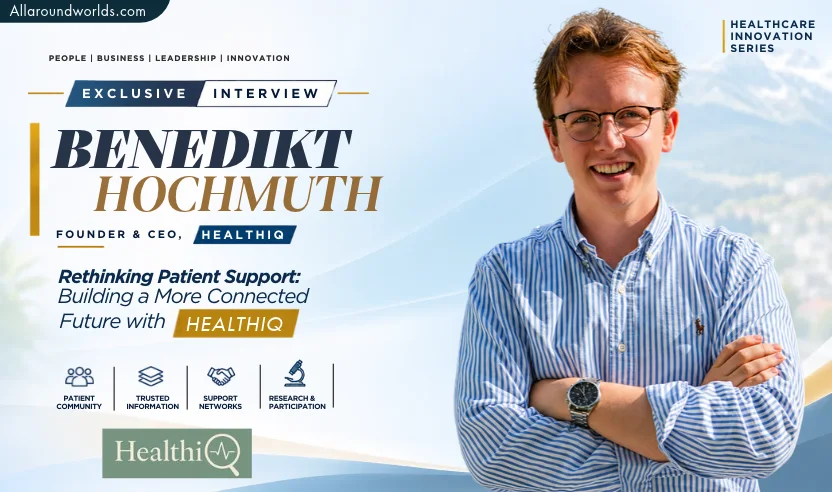
Rethinking Patient Support: Building a More Connected Future with HealthiQ
A diagnosis may come with a treatment plan, medical advice, and access to professional care. Yet for many people living with chronic conditions or disabilities, some of the most difficult questions emerge afterwards. Where can they find someone who truly understands their experience? Which information can they trust? And how can they navigate the many services, organisations, and support networks that exist but are often difficult to connect?
These are among the questions driving Benedikt Hochmuth, Founder and CEO of HealthiQ, an early-stage digital health startup based in Tyrol, Austria. Drawing on his experiences in emergency medical services, healthcare management, biotechnology, and research-oriented entrepreneurship, Benedikt is working to address a challenge that extends beyond medical treatment: making reliable information, peer support, and meaningful participation more accessible to people navigating long-term health challenges.
Together with his co-founders, he is working towards developing HealthiQ into a connected digital patient hub for the German-speaking region. The initiative brings together an ambition to improve access to trustworthy information, pseudonymous peer support, patient organisations, and opportunities for participation, while recognising the importance of privacy, accessibility, and evidence-based development.
In this exclusive interview with AllAroundWorlds, Benedikt discusses the challenges HealthiQ aims to address, the strategic decision that reshaped its direction, the role of patients and organisations in its development, and the research intended to guide its next steps.
The Vision Behind HealthiQ
What inspired you to establish HealthiQ, and which challenges in patient support are you hoping to address?
My motivation comes from a recurring observation across different areas of healthcare: we have an enormous amount of medical knowledge, committed professionals, and valuable support organisations, yet people can still struggle to navigate the resources and services already available to them.
For someone living with a chronic condition or disability, the challenges often continue well beyond the doctor's office. Finding trustworthy information, connecting with people who understand similar experiences, identifying relevant organisations, or discovering opportunities for support and participation can involve navigating numerous disconnected resources. Discussing sensitive health concerns in an environment that feels safe adds another important consideration.
Today, these needs are spread across social networks, messenger groups, search engines, forums, patient organisations, and increasingly AI-based tools. Many of these services offer genuine value, but they were not necessarily designed to function together as one protected, accessible, and trustworthy health environment.
That is the gap we want to address through HealthiQ. Our goal is not to replace professional medical care or existing self-help organisations. We want to make valuable resources and support structures more connected, easier to navigate, and more accessible to the people who need them.
A Connected Patient Ecosystem
How does HealthiQ's digital patient hub differ from conventional online communities, and what progress has the team made so far?
Our long-term ambition is to develop a central digital patient hub for the German-speaking region. Rather than creating another isolated community, we want to connect several elements that people often have to search for separately.
These include pseudonymous peer support, curated health information, guidance, patient and self-help organisations, events, regional support, and, over time, research and participation opportunities.
What makes our approach distinctive is the intended combination of these elements within one connected ecosystem. Privacy and safety by design, accessibility as a continuous development priority, structured connections between stakeholders, and the involvement of people with lived experience are important parts of that concept.
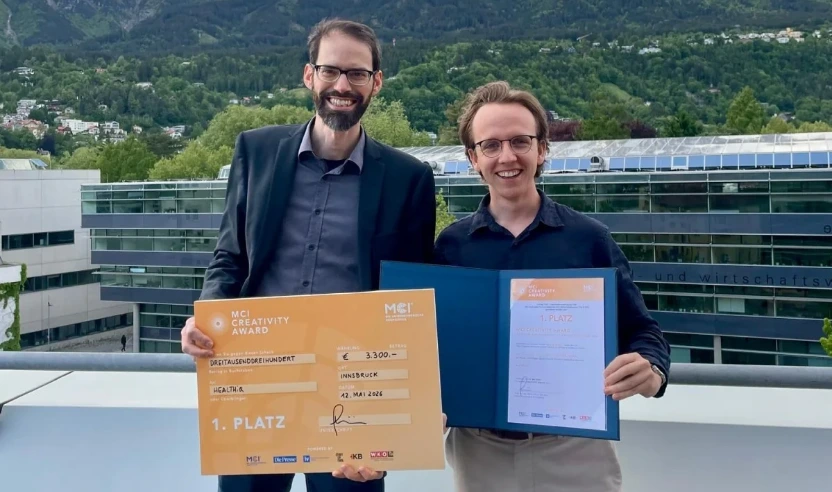
MCI's Center for Social & Health Innovation has also recognised the pioneering ambition behind HealthiQ's proposed ecosystem approach. When we refer to its first-of-its-kind character, we mean the particular combination of these elements, not that other digital support communities, patient platforms, or research initiatives do not exist.
Our first functional minimum viable product has been live since spring 2026. It currently provides eight main community areas with 36 thematic subgroups.
We deliberately treat this MVP as an iterative development environment rather than a finished or fully validated product. There is still a great deal to learn, test, and improve. Our ambition is significant, but we want the platform's development to remain grounded in real needs and evidence.
Refining HealthiQ's Direction
HealthiQ's original concept was considerably broader. What led to the strategic pivot, and how did it change your vision?
HealthiQ looks very different today from its original concept, and I consider that evolution one of the most important parts of our story.
Initially, we wanted to connect multiple parts of healthcare digitally, including patients, medical practices, organisational processes, appointments, and information. The underlying ambition to reduce fragmentation was meaningful, but we eventually recognised that we were trying to solve too many different problems at once.
That realisation was difficult. As a founder, when you invest considerable time and personal energy into an idea, it can be easy to confuse commitment to the problem with attachment to the first proposed solution.
Through conversations with patients, patient organisations, experts, and researchers, we began to recognise a more focused opportunity: creating a safe, accessible, and connected support environment for people living with chronic conditions, disabilities, and long-term health challenges.
This led to a fundamental change in our direction.
“The vision did not become smaller. It became clearer.”
The experience taught me that changing direction is not necessarily a failure of leadership. The greater mistake would be recognising that evidence points towards a different solution and refusing to respond simply because the original idea was your own.
Today, we are much more deliberate about testing assumptions and involving the people affected by our decisions.
Building Trust Through Participation
How do patients, patient organisations, and other stakeholders contribute to HealthiQ's development?
I believe digital health can be technically excellent and still fail to reach the people it is intended to serve. That is why meaningful participation matters so much to us.
Health is deeply personal. People may be dealing with diagnoses, limitations, mental health challenges, uncertainty, or fears they are uncomfortable discussing openly. Chronic illness and disability can also carry stigma, and some individuals have experienced feeling misunderstood, dismissed, or excluded.
If we invite people into a digital environment to share personal experiences, we first have to earn their trust. For HealthiQ, that means taking privacy, pseudonymity, safety, transparent rules, and responsible moderation seriously from the beginning.
It also means recognising that accessibility is not a single checkbox. Someone living with chronic fatigue may face different barriers from someone with a visual impairment, motor disability, or limited digital literacy. We cannot fully anticipate those experiences as a development team working alone.
I therefore see our wider development community as extending beyond the people formally working at HealthiQ. Patients, relatives, patient organisations, experts, and researchers can contribute perspectives that challenge our assumptions and help us improve what we build.
I particularly value the knowledge held by patient and self-help organisations, many of which have spent years or decades supporting their communities. Their experience should not simply be treated as a distribution channel for new technology. It should help shape the solutions themselves. Our cooperation and network partnership with Selbsthilfe Tirol is a concrete example of how we are connecting with established patient and self-help structures as part of HealthiQ's development. This relationship reflects our belief that meaningful innovation should build on existing knowledge and networks rather than attempting to replace them.
Peer support also contributes something different from professional medical care. Medical expertise can help explain a diagnosis or treatment, while lived experience can help someone understand how to navigate everyday life with a particular condition. Both forms of knowledge matter and should complement each other responsibly.
“Trust makes participation possible. Participation helps ensure that we build solutions around people's actual lives rather than our assumptions about them.”
Understanding Patient Needs Across DACH
HealthiQ is undertaking a research project focused on Germany, Austria, and Switzerland. What does the study aim to investigate, and how could its findings influence your work?
The central question behind our research is straightforward: what do adults living with chronic conditions, disabilities, and long-term health challenges, as well as adult relatives and caregivers, genuinely need, and what do we currently only assume we understand?
There is already valuable research on individual conditions, online communities, and peer support. However, broader cross-condition evidence connecting digital information behaviour, accessibility, trust, privacy, moderation, peer support, and participation remains less available, particularly across the German-speaking region.
We want to contribute to addressing that gap through a quantitative study across Germany, Austria, and Switzerland. The aim is to explore the needs of affected adults, their relatives, and caregivers, while identifying differences that may require more flexible and inclusive solutions.
An important part of our approach is that participation begins before the survey itself. Scientific advisors, experts, and patient and self-help organisations have already contributed perspectives and feedback to the development of the questionnaire.
The study forms part of HealthiQ's ongoing research project listed by MCI's Center for Social & Health Innovation, which provides scientific and methodological support. We hope to reach several thousand adult participants through patient organisation and stakeholder networks, although this remains a research target rather than a completed participation figure.
The findings could influence our next development stages, including community structures, accessibility priorities, safety and moderation, information quality, relevant features, and the integration of partner organisations.
I am equally interested in the value the research could provide beyond HealthiQ. Organisations have contributed their knowledge, and we want relevant findings to flow back into the communities that helped make the research possible. Better evidence could also inform future research and other patient-centred health initiatives.
Most importantly, the study is not intended to prove that our existing assumptions are correct. If the evidence challenges them, we need to be willing to reconsider our decisions.
“Research should not be something we use to justify a finished product. It should help shape what we build in the first place.”
Strength Through Collaboration
How does your interdisciplinary founding team support HealthiQ's development?
HealthiQ brings together three complementary perspectives within its founding team. My background is in public health, healthcare management, and business development.
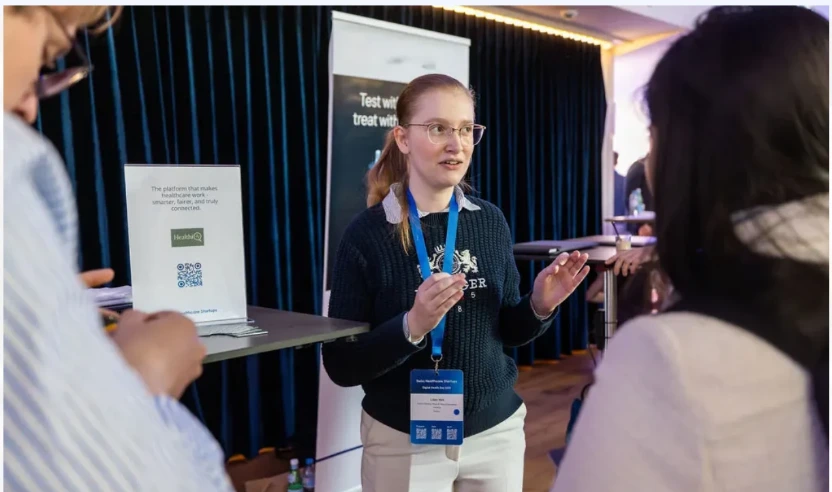
My co-founder Lilien Heit, our Chief Product Officer, is an advanced medical student at the Medical University of Innsbruck. She brings her medical education and training, alongside an understanding of patient and product needs. Our Chief Technology Officer, Arnd Klocker, contributes more than 25 years of software development experience.
These different backgrounds are valuable because developing a digital health platform involves more than one discipline. We have to consider people's needs, the healthcare environment, technical possibilities, and the responsibilities associated with creating a trustworthy digital service.
We also work with a twelve-member interdisciplinary advisory board that brings together expertise from medicine, public health, law, ethics, technology, business, and related fields.
For me, involving people who have more experience or different expertise is not a sign of weakness. It is an important part of making better decisions. We need people who are willing to challenge our assumptions and identify problems we may not have considered.
“Leadership is not about having all the answers. It is about bringing together people who can challenge your answers – and then taking responsibility for what happens next.”
Navigating Early-Stage Challenges
What are the most important challenges facing HealthiQ as an early-stage initiative, and how are you approaching them?
One of our biggest challenges is turning a meaningful vision into a practical, sustainable solution without losing sight of the people it is intended to support.
One important lesson has been the need to balance ambition with practical priorities. Building an early-stage initiative requires us to test assumptions, respond to new evidence, and make thoughtful decisions about where to focus our efforts.
Another challenge is bringing together different stakeholders who may have valuable knowledge but different needs, expectations, and ways of working. Patients, self-help organisations, researchers, healthcare professionals, and technology specialists all contribute important perspectives. Connecting them responsibly takes time, communication, and trust.
We are also conscious that an early-stage platform must develop credibility through its actions. Privacy, safety, accessibility, and information quality are not simply statements we can make once. They require ongoing attention as the product evolves.
For our team, progress means continuing to learn from the people we hope to support, improving the MVP, and building relationships that can contribute to a genuinely useful ecosystem. We do not consider our long-term ambitions achieved simply because the initial platform is live.
A More Connected Future
Looking ahead, what is your long-term vision for HealthiQ and the impact you hope it will create?
Our long-term ambition is to make HealthiQ a leading digital patient hub for the German-speaking region.
I hope that someone receiving a diagnosis, living with a chronic condition, or supporting a family member will eventually know where to turn, not only for reliable information but also for a safe environment, people who understand their situation, relevant organisations, practical guidance, and opportunities to participate.
What concerns me is how isolated people can sometimes feel even within highly capable healthcare systems. A diagnosis does not end when someone leaves a doctor's office or hospital. For many individuals, that is when everyday life with uncertainty, difficult decisions, information overload, and unanswered questions truly begins.
If HealthiQ can eventually help people feel less alone, better informed, safer, and more empowered during those moments, I would consider that meaningful impact.
Our ambition also extends beyond supporting individual users. We want patients and families to have a stronger voice in how support services, digital solutions, and research are developed. Lived experience should contribute to decision-making rather than simply being collected after important decisions have already been made.
If we succeed, HealthiQ could develop into a trusted and sustainable infrastructure connecting patients, self-help organisations, healthcare, research, and other responsible stakeholders. That remains a long-term vision, and reaching it will require continued development, collaboration, and learning.
Ultimately, I do not believe that people who need support should also have to carry the burden of connecting an entire fragmented system themselves. That is what we want to change through HealthiQ.
Conclusion
HealthiQ's development reflects an approach to digital healthcare that begins with understanding people's needs rather than assuming technology alone can resolve existing challenges. Through its evolving patient-support ecosystem, collaboration with organisations, and planned DACH-wide research, Benedikt Hochmuth and his co-founders are working to explore how fragmented resources and communities might become more meaningfully connected.
The initiative remains at an early stage, and its ambitions will require continued testing, evidence, and participation. For Benedikt, the direction remains clear: developing a platform shaped by patients' experiences, where access to relevant information, meaningful support, and trusted connections could become easier over time.
Also Read:-




Recent Comments:
No comments yet.