
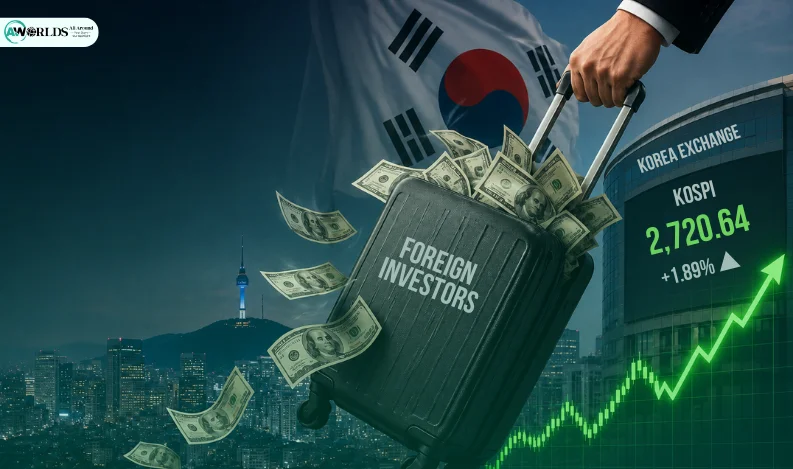
Foreign Investors Pull Billions from South Korean Stocks Despite Record Market Rally
The selling pressure intensified on Monday, with overseas investors offloading approximately 1.24 trillion won (around $801 million) worth of shares listed on South Korea’s benchmark Kospi Index during early trading hours. The market itself came under significant pressure, with the Kospi opening more than 8% lower amid broader weakness across global equity markets.
Despite the ongoing outflows, market analysts argue that the selling is not necessarily a reflection of deteriorating economic conditions or weakening corporate fundamentals. Instead, many believe it is largely a consequence of the market’s extraordinary success.
South Korean equities have posted remarkable gains this year, elevating the country's weighting in major global and emerging-market indices. As a result, many international portfolio managers have been forced to reduce exposure to Korean stocks in order to comply with portfolio allocation limits and risk management requirements.
Analysts describe the trend as a largely mechanical process rather than a vote of no confidence in South Korea’s economy or corporate sector. As share prices rise and benchmark weightings increase, institutional investors often rebalance portfolios by trimming positions, regardless of their outlook on the market.
According to estimates from major investment banks, net foreign outflows from South Korean equities reached approximately $62 billion by the end of May, making it one of the most significant investor repositioning trends in global markets this year.
Market strategists note that a similar pattern has been observed in other rapidly appreciating markets, where strong domestic participation has gradually offset foreign selling pressure. In South Korea’s case, retail investors have emerged as a powerful force supporting the market's advance.
Domestic investors have reportedly poured substantial capital into local equities throughout the year, more than compensating for foreign withdrawals. Increased participation from retail traders and a surge in brokerage account openings have helped sustain demand and maintain market resilience despite international selling.
Another factor contributing to foreign investor caution is growing concentration risk within the market. Much of the Kospi’s recent rally has been driven by a handful of large technology companies, particularly semiconductor giants Samsung Electronics and SK Hynix. The increasing dominance of these companies has raised concerns among some institutional investors about portfolio diversification and exposure limits.
Nevertheless, many investment professionals remain optimistic about the long-term outlook for South Korean equities. Strong corporate earnings, continued technological leadership, and robust domestic investor participation continue to support confidence in the market.
Several major financial institutions have maintained positive forecasts for South Korean stocks, arguing that current foreign selling reflects technical portfolio adjustments rather than a deterioration in economic prospects.
As global markets navigate heightened volatility and investors reassess risk exposure, South Korea’s stock market remains a key focus for international fund managers. The coming months will reveal whether foreign investors return after the recent pullback or continue reducing positions despite the country's strong market fundamentals.






Recent Comments:
No comments yet.