
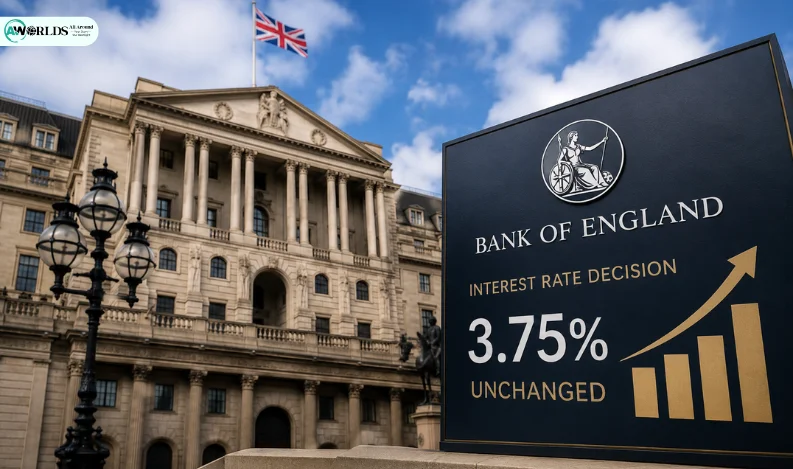
Bank of England Holds Interest Rate at 3.75% as Inflation Eases but Energy Risks Persist
The Bank of England left its benchmark interest rate unchanged at 3.75% on Thursday, maintaining borrowing costs at their current level for the fifth consecutive policy meeting as policymakers weighed easing domestic inflation against renewed geopolitical tensions and rising global energy prices.
The decision, widely anticipated by financial markets, came after Britain's inflation rate slowed more sharply than expected in June. However, officials said uncertainty surrounding the conflict in the Middle East and its impact on energy markets warranted a cautious approach before making further policy adjustments.
The Bank's Monetary Policy Committee (MPC) voted 6-3 in favour of keeping the base rate unchanged. Three members supported an increase, reflecting ongoing concerns that inflationary pressures could intensify again in the coming months.
Interest rates have remained at 3.75% since December 2025 following four reductions during the previous year. The current level represents the lowest UK borrowing cost since January 2023.
Inflation Slows but Remains Above Target
Data released by the Office for National Statistics (ONS) showed that UK consumer price inflation eased to 2.6% in the twelve months to June, down from 2.8% in May and below economists' expectations.
Despite the decline, inflation remains above the Bank of England's 2% target for the 21st consecutive month, reinforcing policymakers' concerns that price pressures have not been fully contained.
Officials acknowledged that recent progress on inflation is encouraging but warned that external developments could quickly reverse the trend.
Middle East Conflict Clouds Outlook
The Bank's latest decision comes as renewed hostilities between the United States and Iran have heightened concerns over global energy supplies.
Escalating tensions have pushed Brent crude oil prices sharply higher after fears emerged that shipping through the Strait of Hormuz, a key route for global oil and liquefied natural gas exports, could face disruption.
Brent crude climbed above $100 per barrel earlier this month before easing to around $91 per barrel on Thursday, remaining significantly higher than levels recorded just weeks earlier.
Higher energy prices are expected to place renewed upward pressure on transportation, manufacturing and household utility costs, potentially slowing progress in bringing inflation back to target.
Markets Eye Further Policy Moves
Although the Bank opted to keep rates unchanged, the voting split suggested policymakers remain divided over the direction of future monetary policy.
Financial markets continue to anticipate at least one additional interest rate increase before the end of the year if inflationary pressures strengthen again.
Richard Carter, Head of Fixed Interest Research at Quilter Cheviot, said markets were unlikely to alter expectations given the latest vote and ongoing geopolitical uncertainty.
"The market is pricing in at least one interest rate rise in the UK this year, and with three members voting for an increase today and events in the Middle East showing no sign of easing the pressure, this won't change," Carter said.
He added that while the new government's measures aimed at easing the cost-of-living burden could provide some relief, they were unlikely to reduce inflation sufficiently to influence near-term interest rate decisions.
Government Policies Also Under Scrutiny
Economists are also monitoring the fiscal agenda of Prime Minister Andy Burnham, whose government has prioritised measures to support households and stimulate economic growth.
Analysts say increased public spending and tax policy decisions will play an important role in determining whether inflation continues to moderate or begins to accelerate again during the second half of 2026.
Focus Shifts to Upcoming Inflation Data
With inflation showing signs of easing but remaining above target, the Bank of England has indicated that future decisions will remain data dependent.
Policymakers are expected to closely monitor developments in global energy markets, domestic wage growth and consumer spending before deciding whether further policy tightening is required later this year.
The next inflation and labour market reports are likely to play a key role in shaping expectations ahead of the Bank's upcoming monetary policy meeting.
More News:-







Recent Comments:
No comments yet.