
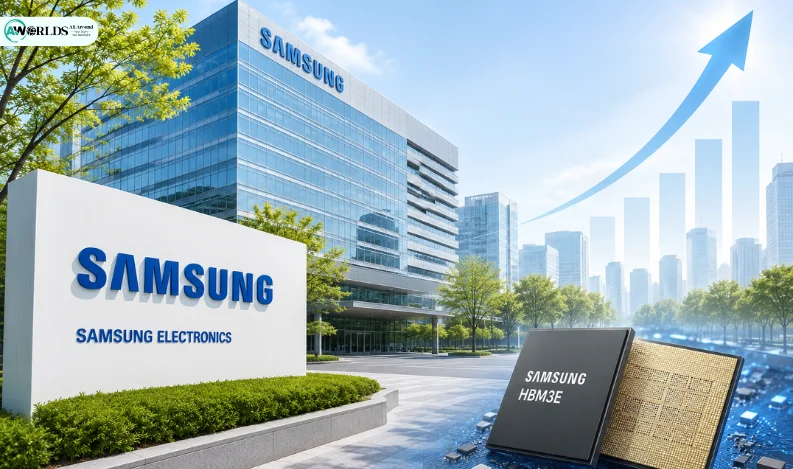
Samsung Q2 Profit Jumps 1,800% on AI Chip Demand
Samsung Electronics reported a sharp surge in second-quarter earnings on Thursday, driven by strong global demand for artificial intelligence (AI) memory chips, as the world's largest memory chipmaker continued to benefit from expanding investments in AI infrastructure.
The company posted an operating profit of 89.49 trillion won ($62 billion) for the April–June quarter, marking a 1,813.8% increase from the same period last year, according to its regulatory filing.
Quarterly revenue climbed 130% year over year to 171.49 trillion won, while net profit rose 1,299.9% to 71.62 trillion won, reflecting robust demand for advanced memory products used in AI servers and data centers.
Samsung said its memory business delivered another record quarter as demand for server-grade memory chips remained strong. Higher global memory prices also contributed significantly to the company's earnings growth.
The results broadly matched market expectations, even as semiconductor stocks came under pressure this week amid concerns that investor enthusiasm surrounding artificial intelligence may have pushed valuations too high.
Samsung shares fell more than 12% during Wednesday's trading session, while rival SK hynix dropped nearly 20%, extending losses despite reporting strong quarterly earnings of its own.
Samsung, SK hynix and U.S.-based Micron Technology remain the world's leading manufacturers of High-Bandwidth Memory (HBM) chips, which are widely used in AI processors powering generative AI applications, chatbots and large-scale data centers.
Looking ahead, Samsung said it expects demand to remain resilient in the second half of the year, supported by continued investment in AI infrastructure and the growing adoption of agentic AI, which enables software to perform tasks autonomously across business workflows.
Earlier this week, Samsung also announced a strategic partnership with Broadcom to supply advanced memory solutions, including HBM chips, for next-generation AI accelerators. Industry estimates suggest the agreement could exceed $200 billion through 2030.
Analysts believe the partnership will strengthen Samsung's position in the AI semiconductor market while helping the company diversify beyond Nvidia, which has historically relied more heavily on SK hynix for HBM supply.
South Korea is also accelerating investment in the semiconductor sector. The government has confirmed plans for Samsung and SK hynix to invest a combined 800 trillion won in four advanced semiconductor fabrication plants, reinforcing the country's long-term ambition to remain a global leader in AI and chip manufacturing.
While analysts remain optimistic about demand over the coming quarters, some caution that the current semiconductor boom may moderate before large-scale manufacturing projects become fully operational.
More News:-







Recent Comments:
No comments yet.