
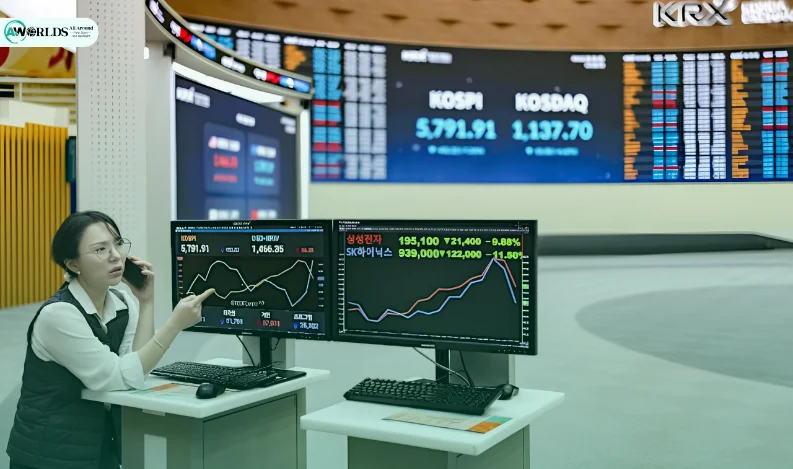
South Korea Market Volatility Nears Record High After Massive Foreign Investor Selloff
South Korea’s financial markets experienced sharp volatility on Monday after foreign investors pulled billions of dollars from local equities, intensifying pressure on the country’s benchmark stock index and raising concerns about broader instability across Asian markets.
The benchmark KOSPI index fell as much as 4% during early trading, extending Friday’s steep 6% decline amid aggressive foreign selling and growing global market uncertainty. Although the market later recovered some losses, volatility remained elevated throughout the session.
According to market data, foreign investors sold approximately $13.2 billion worth of South Korean equities last week, marking one of the largest weekly outflows in recent years. The broader emerging Asian region excluding China also witnessed heavy capital flight, with total outflows estimated at nearly $17 billion.
South Korea accounted for the majority of the regional selloff, while Taiwan recorded the second-largest foreign outflow at roughly $2.5 billion.
The sharp market decline triggered temporary trading restrictions on South Korea’s exchange after KOSPI 200 futures plunged 5%, activating the market’s “sidecar” mechanism designed to reduce panic-driven automated trading. The mechanism paused certain program trades for five minutes in an effort to stabilize market conditions.
The latest downturn comes just days after the KOSPI surged above the 8,000-point mark for the first time, fueled by strong investor enthusiasm surrounding artificial intelligence-related stocks, semiconductor companies, and heavy retail participation.
However, analysts now warn that the market may have become overheated following months of rapid gains.
Strategists at Citigroup said South Korea’s equity market appeared significantly more overbought compared to US markets, prompting the bank to reduce exposure to its bullish Korea investment strategy.
According to analysts, retail investors in South Korea have played an increasingly dominant role in driving market momentum this year, often using leveraged exchange-traded funds and margin trading to increase exposure to fast-rising technology stocks.
While financial institutions stopped short of predicting the end of the rally, they acknowledged that investment risks have risen considerably amid tightening global financial conditions and geopolitical uncertainty.
Analysts also pointed to rising global bond yields and escalating tensions linked to the Iran conflict as additional factors pressuring investor sentiment across Asia.
Despite the volatility, some institutions still see longer-term upside potential for South Korean equities. Goldman Sachs estimated that Korean retail traders purchased roughly $14.1 billion worth of domestic stocks last week, helping partially offset foreign selling pressure.
Market observers further noted that South Korea could continue benefiting from future passive investment inflows tied to upcoming index rebalancing by global index provider MSCI.
The recent market swings underline growing concerns that geopolitical tensions, higher oil prices, and tightening financial conditions may increasingly challenge some of Asia’s strongest-performing stock markets in 2026.






Recent Comments:
No comments yet.