
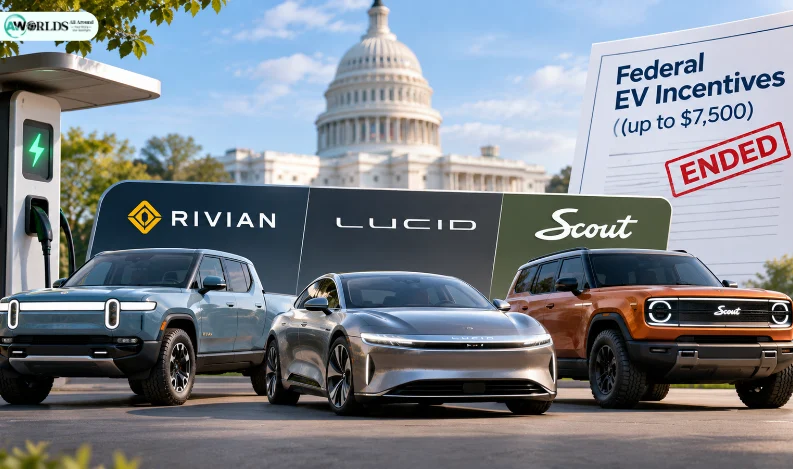
Rivian, Lucid & Scout CEOs Aren’t Counting on Democrats to Restore EV Federal Support
Chief executives of Rivian, Lucid Group and Scout Motors say they are not relying on Democrats to restore federal electric vehicle (EV) incentives, despite the party's gains in the 2026 US midterm elections. The executives believe the industry must prepare for continued uncertainty around government support rather than build business strategies around potential policy changes.
The comments come as US automakers adjust to the end of federal consumer tax incentives worth up to $7,500 for eligible electric vehicle purchases, which were previously introduced to encourage EV adoption.
Automakers Prepare for Policy Uncertainty
Scout Motors CEO Scott Keogh said the company was built to operate without depending on government incentives or legislation that could change with political leadership.
Rivian CEO RJ Scaringe expressed a similar position, saying he hopes Democrats and President Donald Trump can find common ground on policies supporting the EV industry. However, he cautioned that achieving legislative progress could be difficult.
Lucid CEO Silvio Napoli also adopted a cautious approach, saying the company would welcome additional support but was not counting on it.
Democrats Face Competing Legislative Priorities
Democrats are expected to take control of Congress in January 2027 following their midterm election victories. However, restoring EV incentives may not be an immediate priority.
The party is also focusing on healthcare affordability, data centres, Medicaid and oversight of the Trump administration. Nevertheless, some policymakers have indicated that vehicle affordability and domestic EV supply chains could become part of future legislative discussions.
Vehicle Affordability Remains a Major Challenge
The end of federal purchase incentives has increased pressure on automakers to make electric vehicles more affordable without relying on subsidies.
According to Cox Automotive, the average price of a new electric vehicle in September 2026 exceeded $54,800, compared with slightly more than $51,100 for the overall new-vehicle market.
Scout's Keogh said he would prefer government assistance focused on EV production because reducing manufacturing costs could eventually lower prices for consumers.
Industry executives believe long-term EV growth will depend on competitive pricing, production efficiency and consumer demand, regardless of whether additional federal incentives return.
More News:-




Recent Comments:
No comments yet.