
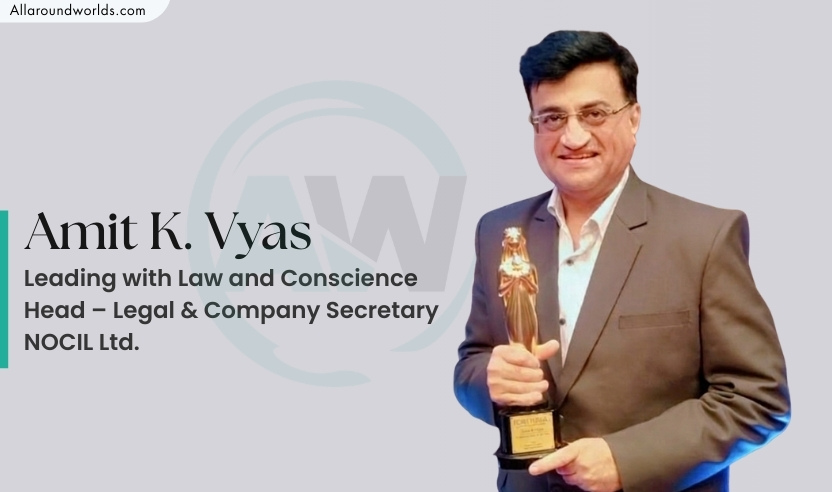
Leading with Law and Conscience: The Journey of Amit K Vyas
Some professional journeys are shaped by opportunity, while others are forged by conviction, clarity of purpose, and an unwavering commitment to principles. Amit K Vyas’s journey belongs firmly to the latter category, defined by a lifelong passion for law, a deep respect for governance, and the courage to choose integrity over convenience at every stage of his career.
From discovering his fascination with court proceedings and legal reasoning during his graduation years at Delhi University to consciously pursuing dual qualifications as a Company Secretary and a lawyer, Amit’s path reflects a deliberate choice to build expertise at the intersection of law, compliance, and business strategy. At a time when the Company Secretary profession was still evolving and often undervalued, he chose to see beyond conventional roles, shaping a career focused on adding tangible value at the Board and organizational level rather than limiting himself to procedural compliance.
With over three decades of experience across diverse industries, including manufacturing, FMCG, investment banking, heavy engineering, and specialty chemicals, Amit has consistently worked to integrate legal, secretarial, governance, ESG, and risk management functions into a cohesive strategic framework. Currently serving as Head – Legal and Company Secretary at NOCIL Ltd., a listed market leader in the rubber chemicals sector, he operates as a trusted advisor to the CEO and Board, ensuring that law, ethics, and business objectives move in alignment.
This journey article takes readers through the defining moments, professional challenges, landmark legal victories, leadership philosophies, and principled standpoints that have shaped Amit K Vyas’s career. From navigating difficult corporate environments to winning precedent-setting legal battles and building high-performing governance frameworks, his story offers valuable insights for professionals across legal, compliance, and leadership domains. Readers are encouraged to explore the full article to understand how conviction, resilience, and professional integrity can create lasting impact in the corporate world.
Early Life, Education, and Career Journey
Amit’s inherent passion for pursuing a career in law came to the fore during his graduation days in B.Com at Delhi University in 1986. During those years, he was fond of reading reports on legal cases published in newspapers and keeping cuttings for his personal records. Even while watching movies, he found himself fascinated by scenes involving court proceedings and lawyerly combat. Even today, he remembers the cases he had read during those days, nearly four decades later.
During the final year of his B.Com, while many of his friends dreamt of becoming Chartered Accountants and Cost Accountants, Amit always aspired to become a Company Secretary with a legal qualification and be recognized as a top corporate lawyer. This was back in 1987, when the Company Secretary profession was not yet well established and Company Secretaries were still not treated at par with Chartered Accountants by corporates. He never did well in Maths and Accounts, and the typical calculative figure work was beyond his domain, whereas drafting skills and the ability to express logical arguments on matters of social and professional interest were his strengths.
After completing B.Com, he pursued CS and LL.B. from Delhi University and completed both courses simultaneously. He considers those years among the most exciting times of his life, as he enjoyed attending classes, arguing with professors, participating in debates on controversial subjects, and writing short articles on the latest legal issues.
While studying for CS, he thoroughly enjoyed subjects such as Company Law, the Capital Issues Control Act now under SEBI, Consumer Protection, and MRTP, presently known as the Competition Act.
Thus, Amit became a Company Secretary and a lawyer by choice and not by accident.
From day one, back in 1992 when he started his career as a Management Trainee, his approach has been to contribute to an organization both as a Company Secretary and a legal functionary, instead of confining himself exclusively to either the CS role or the corporate lawyer role. In his view, this is where value addition to the Board, and consequently to the business, gets recognized.
He also observed that many of his peer-level professional friends made the mistake of focusing only on the corporate secretarial role and were branded as Company Secretaries mandated by law, with expertise seen as limited to maintaining statutory records and handling Board and General Meetings.
His areas of exposure evolved as he progressed through the organizations he worked with, facing varied experiences and challenges posed by each business. It has been a tough journey, marked by toxic work environments, hostile superiors, and professional animosity from CFOs and other finance professionals who often treated a Company Secretary as an inferior being, a cost centre, and a back-office function. As a legal functionary, he was often confronted with mindsets that saw the legal professional as business-averse and merely capable of raising objections.
Current Role and Professional Focus
Amit is a Fellow Member of the Institute of Company Secretaries of India and a first-class law graduate from Delhi University. He brings more than 30 years of experience as a highly resourceful and skilled Company Secretary and Corporate Lawyer, Legal Head, and Counsel. His areas of exposure and expertise include Corporate Secretarial Function, Corporate Governance, Legal and Statutory Compliance Mechanisms, Litigation and Arbitration, Contract Management, Sustainability and ESG initiatives, CSR-related compliances, ESG policy formulation and implementation, Due Diligence and Audit, Stakeholder Management and Investor Servicing, and Risk Management and mitigation. Since starting in 1992 as a Management Trainee, he has consciously integrated legal and secretarial functions to deliver tangible Board-level value rather than limiting himself to compliance alone.
He is presently the Head – Legal and Company Secretary of NOCIL Ltd., a position he has held since April 2019. NOCIL Ltd. is the largest rubber chemical manufacturer in the country and is listed on the BSE and NSE, with a market capitalization of Rs. 4,368 crores. In this role, he oversees the entire gamut of corporate legal, secretarial, and governance functions, including ESG, Risk Management, Corporate Governance, CSR, overall compliance with applicable laws, litigation, legal advisory, and stakeholder and investor servicing. He functions both de facto and de jure as the Chief Legal Advisor to the CEO and the Board, apart from being a Key Managerial Personnel in his capacity as Company Secretary.
Since April 2019, he has led the legal and company secretary functions at NOCIL Ltd., overseeing governance, statutory compliance, litigation, contracts, ESG and CSR initiatives, risk management, and investor relations. As Chief Legal Advisor to the CEO and Board, he ensures that law, governance, and strategy converge to drive sustainable business impact. Awards such as the Forttuna Global Excellence Award 2025 and Legal Era’s Legal Team of the Year 2023–24 reflect the success of this integrated approach.
At the macro level, he has been able to guide NOCIL through complex regulatory frameworks, global compliance challenges, digital governance initiatives, and ESG-aligned sustainability strategies. Under his leadership, the legal function has become a strategic enabler of investor confidence, corporate integrity, and long-term growth, influencing decisions that shape the company’s trajectory both nationally and internationally.
At the micro level, he serves as a trusted advisor to the Board and individual directors, guiding succession planning, ethical decision-making, operational governance, and risk management. His meticulous approach ensures that compliance, corporate ethics, and regulatory frameworks are embedded into daily business operations, aligning governance with strategic decision-making, operational excellence, and sustainable impact.
His career spans a diverse range of organizations, including promoter-driven companies, public sector undertakings, multinational corporations, and professionally managed enterprises. He has dealt with diversified businesses spanning manufacturing, investment banking, heavy engineering, FMCG, agriculture, and specialty chemicals.
Amit also developed a keen interest in writing on legal topics, latest case laws, and their implications during his graduation days. After initial struggles, he built an extraordinary flair and passion for writing on legal issues. He began contributing numerous articles on Company Law since 1992 to Chartered Secretary, a leading publication of the Institute of Company Secretaries of India with one of the largest circulations in corporate law.
- He wrote his first book on the Companies Amendment Act, 2000, published through Snowhite Publishers, in the year 2000, and it was well received in professional circles. Encouraged by the response, he authored another book on SEBI Insider Trading Regulations in 2001, regarded as the first book on Insider Trading in the country.
- He has never stopped writing or contributing articles over the last 30 years and has, to date, written numerous pieces on Constitutional Law, Corporate Law, Arbitration and Mediation, Securities Laws, and Anti-Trust, among others, for publications including:
- Chartered Secretary-a leading publication of the Institute of Company Secretaries of India with wide circulation over the last 20 years
- Legal Era (one of India’s top legal e-magazines)
Proudest Professional Accomplishments
So many of them. The proudest being the latest recognitions at NOCIL Ltd
Amit considers there to be many, with the proudest being the latest recognitions at NOCIL Ltd.
Winning top awards in a span of just two years across multifarious areas, including CSR, Compliance Management, Sustainability, Risk Management, and as the Best Performing Legal Team in the category of small-cap companies
(Awards received in the past 2 years – a bird’s-eye view:
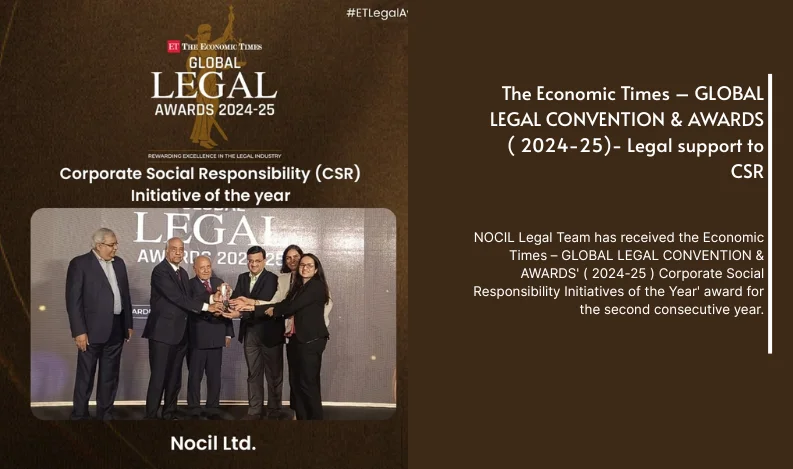
- The Economic Times Global Legal Convention and Awards in the category of Corporate Social Responsibility Initiatives of the Year, 2023
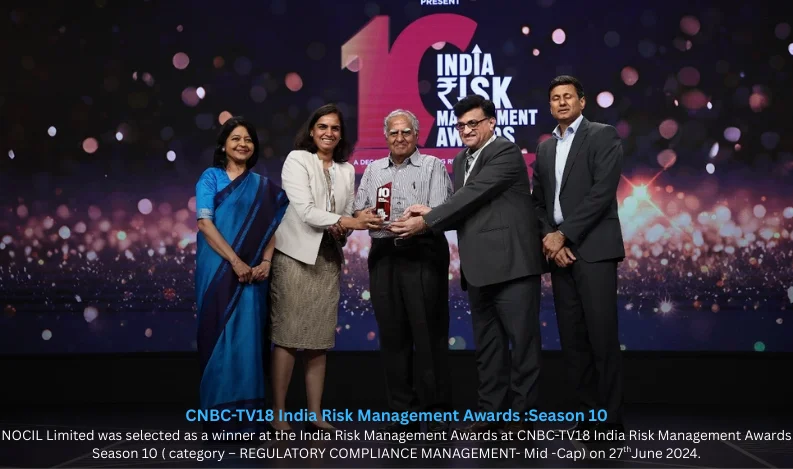
- Winner of the India Risk Management Awards (Season 10, CNBC-TV18) for Regulatory Compliance Management (Mid-Cap category) on June 27, 2024
- Winner of Legal Team of the Year (Small Size) at the Legal Era Forum, 2023–2024
- Bagged the India Legal Award on February 8, 2024, at the General Counsel Vision and Innovation Summit and Awards 2024
- Won the Vision Awards 2023 for Best Sustainability Report in the Chemicals sector
- Secured a Platinum LACP Award for NOCIL’s Sustainability Report 2022–23, scoring 99 out of 100
Major Career Challenges
When Amit entered the profession in 1992, corruption was at its peak. Almost every government department that companies dealt with, particularly the Department of Company Affairs, now the Ministry of Corporate Affairs, and the Registrar of Companies, operated in a manner where nothing moved without palm greasing. Even for the physical filing of statutory documents, long before digitalization, money had to be paid simply to procure a basic receipt evidencing filing. Certificates of registration of charge against assets on loans procured by companies would not be issued unless bribes were paid. The amounts demanded were often dictated by the size of the company, its profit after tax, turnover, and similar factors. The same situation existed across other government departments, and as a professional, Amit deeply opposed this culture. When he raised questions about why such practices should be followed despite legitimate business intentions, he was often given the standard answer by superiors: “Be a Roman in Rome and an Indian in India.”
He recalls that in 2001, when he was interviewed for a senior position by a pharmaceutical company, the entire discussion revolved around one question: his ability to manage. He replied that he could manage work pressure very well. However, the question was not about managing work, but about managing influential officials in ministries who would approve applications and grant exemptions at a price. He could never bring himself to accept such a role, even if it came with significantly higher monetary benefits.
He notes that things have changed drastically over the last 15 years with rapid digitalization across the country, the enactment of the new Companies Act in 2013, which dispensed with many government approvals on internal corporate matters, and the elimination of direct interfaces with officials. According to him, the attitude of government officials has also changed significantly in the last decade, becoming more progress-driven and supportive rather than fault-finding and cash-thirsty.
Other professional challenges:
Beyond corruption, Amit points to a range of other professional challenges. While corporate governance standards, ethical conduct, and HR practices have improved over the past two decades, the experiences faced by many Company Secretaries and legal heads, including himself, during the early and even later years of the profession remain worth sharing with younger professionals. He always believed that merit, intelligence, and capability should be the winning factors, but in reality, he often encountered power-centering, caste- and language-based biases and prejudices, appeasement of those in power, behind-the-back reporting, and personal loyalty being valued over corporate loyalty.
He also reflects on a time when work-life balance was virtually non-existent. Working 12-hour days was common despite family obligations, weekends were not considered personal time, and employees were expected to be completely prepared every Monday like schoolchildren. Leave was granted only in severe illness, and in some cases, bosses even verified through their own sources whether employees were genuinely sick or simply on holiday. He notes that many professionals suffered personally under this pressure, leading to separations, domestic conflicts, and distress for children. It was, in his words, a heavy price paid by those who could not bear the pressure.
In one very large engineering corporation, despite its reputation for highly qualified engineers, he witnessed rampant intra-functional conflict based on caste. He recalls that foreign partners, particularly the Japanese, were shocked at the cultural cold wars affecting performance.
In his assessment, much has still not changed in typical Indian managerial mindsets.
“When power goes to the head, arrogance creeps in, and the so-called leaders soon turn into self-proclaimed dictators running their companies as personal fiefdoms.”
He believes that those who surrender themselves to power centres are often rewarded with leftovers, while the most committed performers suffer endlessly in offices and then again at home under personal stress. In his view, unless top leadership truly lives by the values it proclaims in vision and mission statements, committed employees will neither be acknowledged nor rise to the top.
Challenges at a personal level:
At a personal level, Amit shares that he was unable to give adequate time to his family due to work pressure, especially in an era when working from home on a laptop was not an option. Fortunately, his spouse, also a qualified Company Secretary who gave up her profession for their two children, understood the rigours and pain he went through and supported him during those difficult years. That support kept him going.
He believes he could have held an even more senior position today had he chosen sycophancy and appeasement, but he has no regrets. He remained steadfast to his principles, never bowed to power centres, and never compromised for dirty politics.

Staying Ahead in the Industry
Amit’s aspirations and goals for a vibrant legal and compliance function are clear:
- To always add value and support to the business, rather than functioning as a fault-finder with a negative approach
- To work in a principle-based organisation that challenges him to evolve professionally while contributing to the organisation’s growth
- To pursue the objective of building a powerful and updated legal team that is process-driven and supported by inbuilt succession planning tools
His strengths, which he has always applied to the maximum, include:
- Always opting for the harder right rather than the easier wrong
- Strong commercial awareness and a love for all things legal, making corporate commercial laws a particularly strong area of interest
- Immense curiosity to learn different facets of law and business operations, pushing him to work hard and develop newer skill sets
- Strong client-service and customer orientation, along with the ability to form good working relationships
- A high degree of independence, initiative, and decisiveness
- Strong analytical skills and the ability to demonstrate sound legal and business judgment, while working independently and contributing successfully to cross-functional teams
- Excellent organisational skills and the ability to manage multiple projects simultaneously to meet deadlines
Advice to Young Professionals
Amit advises young professionals to follow the ICSI motto, “Speak the Truth, Abide by the Law.” In his view, no exceptions are permitted. There should be no question of gross negligence on the part of a Company Secretary in matters of compliance with corporate and securities laws where direct accountability exists.
He believes that young professionals are the future conscience keepers and torch bearers of good corporate governance, and he encourages them to remain steadfast in their commitment to implementing best-of-breed governance practices.
He also emphasizes the importance of loving one’s profession ahead of any employer or client. In his words, an employer or client may leave one day, but the profession never will.
Conclusion
Amit K Vyas’s professional journey stands as a testament to what it means to practice law and governance with conscience, courage, and consistency. Across decades of evolving corporate landscapes, regulatory reforms, and organizational challenges, he has remained anchored to a simple yet powerful belief: that legal and compliance functions exist not merely to prevent risk, but to enable responsible, sustainable business growth. His career reflects a rare balance of technical expertise, commercial awareness, and moral clarity.
From confronting systemic challenges in the early years of the profession to shaping integrated legal and governance frameworks at the highest levels of corporate leadership, Amit has demonstrated that long-term credibility is built through principled decisions, not shortcuts. His approach to integrating legal, secretarial, ESG, risk management, and stakeholder engagement functions has helped position governance as a strategic pillar rather than a back-office obligation. In doing so, he has influenced boardroom thinking and strengthened institutional trust.
Equally significant is his role as a mentor, writer, and thought contributor, consistently sharing knowledge through publications, professional forums, and practical guidance for the next generation. His advice to young professionals underscores the enduring value of integrity, accountability, and respect for the profession itself, qualities that remain relevant regardless of changing regulations or business models.
As this journey concludes, Amit K Vyas’s story serves as a reminder that true professional success is not measured solely by titles or accolades, but by the principles one upholds, the standards one sets, and the impact one creates over time. His path offers valuable perspective for professionals aspiring to lead with purpose, build credibility through ethics, and leave a lasting imprint on corporate governance and legal leadership.
Also Read:-




Recent Comments:
No comments yet.