
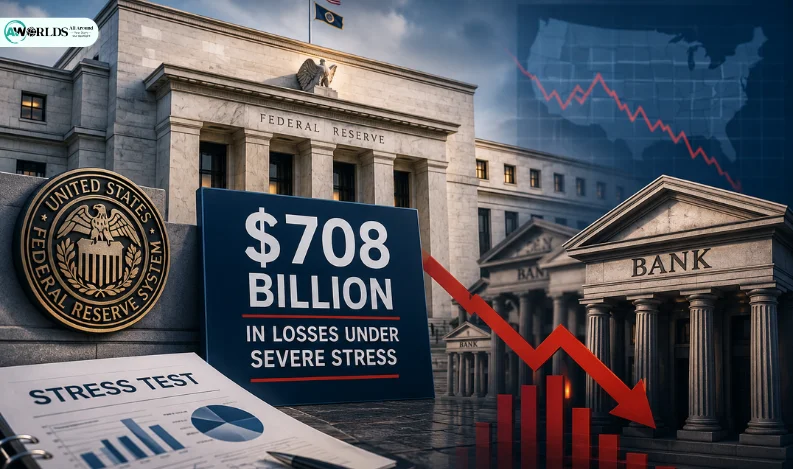
Federal Reserve Says U.S. Banks Can Endure $708 Billion in Losses Under Severe Economic Stress
The U.S. Federal Reserve has concluded that the country's largest banks remain financially resilient, with all 32 institutions successfully passing its annual stress test despite a hypothetical global recession that would generate more than $708 billion in projected losses across the banking sector.
The results, released on Wednesday, indicate that major U.S. lenders possess sufficient capital to continue lending to households and businesses even under one of the most severe economic downturn scenarios modeled by regulators.
The Federal Reserve's 2026 stress scenario assumed a sharp deterioration in economic conditions, including unemployment rising to 10%, a 39% decline in commercial real estate values, and a 30% fall in residential home prices. Despite these extreme assumptions, every participating bank maintained capital levels above the minimum regulatory requirements.
A key indicator of banking strength, the Common Equity Tier 1 (CET1) capital ratio, declined by only 1.6 percentage points during the simulated downturn, remaining comfortably above mandatory thresholds. According to the Federal Reserve, projected losses included approximately $200 billion from credit card lending, $160 billion from commercial and industrial loans, and $75 billion tied to commercial real estate exposure.
Federal Reserve Vice Chair for Supervision Michelle Bowman said the results demonstrate the continued resilience of the U.S. banking system, highlighting the industry's ability to absorb significant financial shocks while maintaining its essential role in supporting economic activity.
This year's stress test arrives during a period of regulatory transition. Unlike previous years, the results will not directly influence banks' capital requirements because the Federal Reserve announced earlier in 2026 that existing stress capital buffers would remain unchanged through 2027. The decision allows regulators additional time to revise the stress-testing framework in response to industry feedback regarding its methodology.
The ongoing review is expected to play an important role in shaping future banking regulations, particularly as policymakers prepare to introduce the long-awaited Basel III Endgame capital framework later this year. The updated international standards are expected to redefine how banks calculate and maintain capital against potential future risks.
Financial analysts have suggested that this year's exercise carried limited regulatory consequences compared with previous stress tests. Research firm KBW described the assessment as largely procedural, noting that investors and banking executives are focusing more closely on the forthcoming Basel III reforms than on the immediate stress test outcomes.
According to KBW's analysis, institutions including Morgan Stanley, Citigroup, Citizens Financial Group, and KeyCorp could have experienced some of the largest reductions in required capital buffers if this year's stress test results had been used to determine regulatory capital requirements.
The Federal Reserve's latest findings reinforce confidence in the strength of the U.S. banking sector, suggesting that large financial institutions remain well-positioned to withstand severe economic disruptions while continuing to provide credit and liquidity to businesses and consumers.






Recent Comments:
No comments yet.