
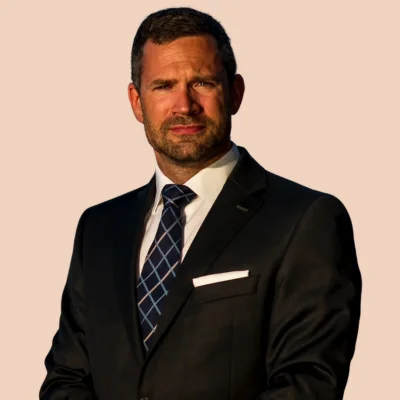
About
Some leaders learn to make decisions in meeting rooms. Others develop that ability in environments where uncertainty is constant, information is incomplete, and the consequences of getting it wrong can be immediate. For Fredrik Ahlén, more than 25 years across international security, crisis management, corporate governance, and entrepreneurship have created a leadership perspective shaped by both worlds.
Ahlén’s professional journey has taken him from some of the world’s most challenging geopolitical environments to senior security and governance positions within major Western organizations. That transition, from managing risk on the ground to helping corporations anticipate it at the strategic level, has become central to his work today and to the philosophy behind OmegaNova: understanding and reducing “The Cost of Not Knowing.”
His understanding of uncertainty was shaped early. Ahlén survived a multi-week abduction and threat environment in Nigeria, an experience that contributed to his awareness of human resilience and the realities of unpredictable environments. Professionally, those lessons would later be tested and refined through assignments across East Africa and the Middle East.
During his international security career, Ahlén worked in 19 countries including complex environments such as Somalia, Iraq, South Sudan, Afghanistan. As a Security Coordinator supporting engagements connected with the Swedish Ministry for Foreign Affairs and Scandinavian Risk Solutions, he directed security operations, conducted threat assessments, developed crisis and evacuation procedures, and led close-protection personnel. His work supported Sweden, Norway, Denmark, Germany, and the European External Action Service, while his broader international experience required close engagement with governments, diplomatic stakeholders, and local actors.
Across these environments, Ahlén came to understand something that conventional risk models can easily overlook: risk is rarely explained by data alone. Decisions are also shaped by people, culture, relationships, history, and local structures. Navigating what he describes as the “human terrain”, including dynamics of honor, shame, and clan-based decision-making, became an important part of understanding why people behave as they do, particularly where formal institutions may have limited influence.
Ahlén subsequently brought this operational experience into major corporate environments. As a Regional Security Advisor for Microsoft Global Security, through Pinkerton, he provided strategic and operational direction across the Nordic region, including security programs, life-safety initiatives, government liaison, and employee preparedness. At Alstom Rail Sweden, he served as Head of Real Estate & Security and Head of Protective Security, overseeing security and facilities across more than 30 locations in Sweden and Finland and a workforce of approximately 40 employees. His work included organizational protective security, major office projects, and initiatives that delivered significant operational savings.
He later became Head of Group Security at Sinch Sweden, where he built the company’s first security management system from the ground up in a zero-state environment. His responsibilities extended across global security culture, risk management, incident response, travel security, compliance, and organizational resilience. Among his initiatives were a global security-awareness program, an international incident-response capability, a dedicated security communications platform, and a security risk-management policy framework introduced within his first 100 days.
This combination of frontline experience and corporate leadership now informs Ahlén’s entrepreneurial direction. Having founded Tracemind AB as a security management consultancy, he is channeling decades of experience into advanced approaches to foresight and predictive intelligence. Central to that direction is OmegaNova, an intelligence operating system designed to quantify, simulate, and forecast geopolitical and operational risks before they develop into crises. Recognizing that corporate teams often lack the time and analytical capacity to process raw risk data, OmegaNova is built to eliminate ambiguity, delivering tailored direct, decision-ready answers rather than generating further questions or the need for corporations to translate - what does this mean to us?
At its core is Core Omega Phoenix™, a simulation engine that applies structured analytic techniques, including Quadrant Crunching and Premortem Analysis, to examine alternative futures and strategic pathways. OmegaNova is designed to identify weak signals and early indicators, model scenarios across operational horizons, and translate fragmented information into actionable foresight. Its approach also incorporates cultural intelligence to help reduce the risk of “mirror imaging”, assuming other actors will interpret situations or make decisions through the same cultural lens.
Ahlén places particular importance on analytical discipline. OmegaNova’s framework is designed to distinguish observed facts from modeled simulations, maintain traceability to underlying sources, and produce assessments with explicit confidence levels, evidence labels, and resolution criteria. The objective is not to claim certainty about an uncertain future, but to give decision-makers a more structured way to recognize emerging possibilities early enough to act.
That philosophy is captured by “The Cost of Not Knowing.” For Ahlén, insufficient foresight can affect three forms of organizational value: financial capital, human capital, and operational continuity. Earlier warning can provide organizations with more time to protect supply chains and manage market exposure, strengthen duty of care for people operating near instability, and reduce the executive time, disruption, and reputational damage associated with reactive crisis management.
These ideas will also form part of Ahlén’s forthcoming book, scheduled for publication in autumn 2026. Bridging lessons from high-risk environments with the realities of modern corporate leadership, the book explores clarity in chaos, human terrain, operational resilience, and the transition from reactive crisis response to predictive leadership.
Fredrik Ahlén’s journey demonstrates how experience gained under extreme uncertainty can evolve into a framework for business leadership. As global organizations face increasingly interconnected geopolitical, operational, and human risks, his focus is shifting the conversation from responding effectively after disruption occurs to recognizing what matters before it does. In that shift lies the principle guiding his next chapter: the greatest risk may not always be the threat an organization can see, but the cost of what it does not yet know.

