
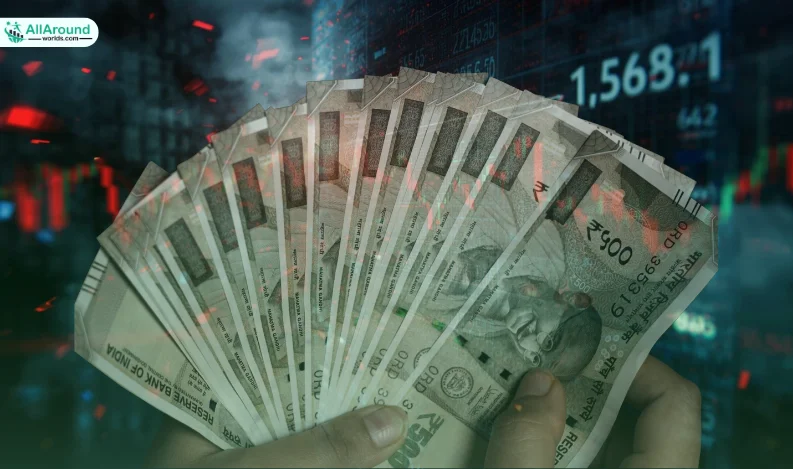
Asia’s Worst-Performing Currency Faces Volatile Start to 2026
New Delhi: The Indian rupee has emerged as Asia’s weakest-performing currency this year and is expected to face continued volatility as it heads into early 2026, weighed down by trade uncertainty with the United States and sustained foreign investor outflows.
Market forecasts suggest the rupee could slide to 92 against the US dollar by the end of March 2026, according to estimates from Nomura and S&P Global Market Intelligence. The currency was last trading near 89.6 to the dollar, having weakened steadily through the second half of the year.
Analysts say progress on a long-awaited US–India trade agreement remains the key catalyst for any meaningful recovery. Without clarity, foreign capital flows are expected to remain cautious.
“We see the rupee as undervalued at current levels, with any correction dependent on clearer signals around the US–India trade deal,” said Hanna Luchnikava-Schorsch, Head of Asia-Pacific Economics at S&P Global Market Intelligence. The firm expects a potential agreement to materialise within the next six months.
Trade tensions have intensified pressure on the currency. India remains among the most heavily tariffed major economies globally, with duties reaching as high as 50%, significantly impacting export competitiveness. Following the imposition of steeper tariffs in August, Indian exports to the US declined sharply in September and October before rebounding strongly in November.
According to economists, prolonged uncertainty risks slowing India’s gains from global supply chain realignments, particularly among firms serving the US market. “Sustained high tariffs could weaken investor confidence and reduce supply-chain inflows,” said Sonal Varma, Chief Economist for India and Asia ex-Japan at Nomura.
Foreign portfolio investor sentiment has remained notably weak. Data from National Securities Depository Limited show net foreign outflows exceeding $10 billion across asset classes this year, with nearly $18.5 billion withdrawn from Indian equities alone on a year-to-date basis.
Market participants note that the rupee’s decline is not driven by a widening current account deficit, which remains within a manageable 1%–1.5% range. Instead, persistent capital outflows have been the dominant factor keeping the currency under pressure.
Earlier this month, the rupee breached the psychologically significant 90-per-dollar level, having started the year at 85.64. The slide accelerated rapidly, with the currency crossing 91 in less than three weeks.
While a weaker rupee could improve export competitiveness, analysts caution that prolonged depreciation may increase import costs and fuel inflationary pressures. India’s central bank, which has reiterated its preference for market-determined exchange rates, is reported to have intervened intermittently to smooth excessive volatility.
As 2026 approaches, economists expect the rupee’s trajectory to remain closely tied to trade negotiations, global risk sentiment, and the pace of foreign capital returning to Indian markets.




Recent Comments:
No comments yet.