
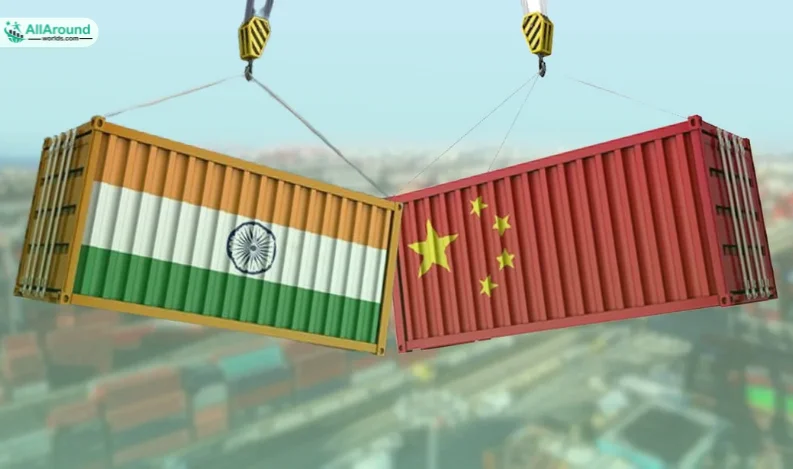
India exports to China jump in December as U.S. shipments fall on tariffs
India’s exports to China surged sharply in December while shipments to the United States declined, underscoring how higher U.S. tariffs are reshaping New Delhi’s trade flows and accelerating diversification toward alternative markets.
Government data released late Thursday showed exports to China jumped 67% year on year to $2 billion in December. In contrast, shipments to the U.S,India’s largest export destination, fell 1.8% to $6.8 billion.
The shift comes as the U.S., under President Donald Trump, imposed tariffs of up to 50% on Indian goods, among the highest levied on any major trading partner. The measures have strained bilateral trade ties and prompted Indian exporters to deepen engagement with Asian and other global markets.
During the first nine months of the fiscal year ending March 2026, India’s exports to mainland China rose nearly 37%, while shipments to Hong Kong increased more than 25%, reflecting a broader pivot toward East Asia.
China has now emerged as India’s largest merchandise trading partner. Trade between the two countries stood at $110.20 billion between April and December 2025, surpassing India–U.S. trade of $105.31 billion over the same period, according to data from India’s commerce ministry.
Diplomatic engagement has also picked up. Earlier this week, India’s Foreign Secretary Vikram Misri met Sun Haiyan, vice minister of the International Department of the Communist Party of China, in New Delhi to review progress in stabilising bilateral ties, with a focus on business and people-to-people exchanges. Relations have gradually thawed since Prime Minister Narendra Modi met Chinese President Xi Jinping at the Shanghai Cooperation Organisation summit in September.
Despite growing trade volumes, India’s imbalance with China remains a key concern. Between April and December, India ran a trade surplus of more than $26 billion with the U.S., while its trade deficit with China widened to $81.7 billion, highlighting starkly different trade dynamics with its two largest partners.
India’s overall merchandise trade deficit also expanded in December, rising 21.4% year on year to $25 billion. Exports increased 1.9% during the month, while imports grew 8.8%, although the deficit came in below a Reuters poll estimate of $27 billion.
The December figures followed a strong rebound in November, when exports rose 19.4% and shipments to the U.S. climbed 22.6% amid hopes of a possible bilateral trade agreement.
India’s Trade Secretary Rajesh Agrawal said this week that New Delhi was “very near” to finalising a deal with Washington, though he declined to give a timeline. Negotiations have dragged on for months, with both sides acknowledging the complexity of reaching an agreement.
Meanwhile, India has stepped up efforts to diversify export markets. Officials say New Delhi is close to concluding a long-awaited trade agreement with the European Union and has already entered trade pacts with the UK, Oman and New Zealand, expected to be signed in the first half of 2026.
Export bodies say diversification is critical as global trade patterns shift. The Federation of Indian Export Organisations said India’s export base remains resilient, with key destinations including the UAE, China, the Netherlands, the UK and Germany alongside the U.S., helping cushion the impact of tariff-driven disruptions.






Recent Comments:
No comments yet.